Blog
  • 18.06.2025

Teachers are at the center of the new Continental Strategy for Education in Africa 2026 to 2035 (CESA 26-35)

This blog post is co-authored by Sophia Ashipala, Head for Education at the African Union Commission, and Quentin Wodon, Director of UNESCO’s International Institute for Capacity Building in Africa.
 

Education remains a top priority for Africa. As part of work carried under the Year of Education in 2024, the African Union conducted a review of the Continental Education Strategy for Africa 2016-2025 (CESA 16-25) and prepared a new strategy for 2026-2035 (CESA 26-35). The new strategy was approved at the African Union’s summit in February 2025 and is now available on the website of the African Union. Separately, the African Union also approved a new strategy for Technical and Vocational Education and Training (TVET), also now available online.

CESA 26-35 comprises of four parts: (1) A brief investment case; (2) A review of selected challenges; (3) A framework for action; and (4) A discussion on governance, communications, and monitoring. Part I for the investment case considers (i) Human rights, peace and sustainable development, including considerations related to gender, equity, and inclusion; (ii) Health and social benefits; and (iii) Labor market benefits. Part II reviews progress (or the lack thereof) for schooling and learning, as well as the links between both. It also provides a summary of key findings from the CESA 16-25 review. Part III is the core of the strategy. It provides a framework for action with six strategic areas of focus and 20 objectives. Part IV is about governance, communications, and data for monitoring and evaluation (M&E).

Teachers are at the core of CESA 26-35, with three objectives under the second strategic area in the strategy that focuses on teachers. These three objectives are: (1) Improve teacher policies, education, professional development, and accountability; (2) Increase the attractiveness of the teaching profession; and (3) Invest in school leadership including the share of female leaders where needed. The other five strategic areas under CESA 26-35 focus on (i) Resources and the enabling environment; (ii) Pre-primary to secondary education, with a focus on early learning and foundational, socio-emotional, and 21st century and labor market skills; (iii) Higher Education and TVET; (iv) Second chance programs and lifelong learning; and (v) Gender, equity, and inclusion. Several cross-cutting themes are also mentioned, including (1) digitalization and AI; (2) greening education; and (3) education in emergencies.

A simple visual aims to facilitate communications around strategic areas. The Figure below conveys the idea that education systems must be built, like a house or structure. The first two strategic areas, including the area focusing on teachers, are the foundations, followed by three pillars combined into one strategic area. These pillars relate to the foundational, socio-emotional, and 21st century skills that learners must acquire, especially through pre-primary to secondary education. Those skills also need to be emphasized at higher levels of learning, as well as in second chance programs and lifelong learning, but the period from pre-primary to secondary education is essential. Next come educational opportunities through Higher Education and TVET, and programs for children and youth out of school and for lifelong learning for adults. The roof and outside walls that encompass the whole system must ensure gender-transformative approaches, equity, and inclusion. Finally, the text at the base of the structure highlights a few critical mega-trends that education systems must adapt and respond to.

FrameworkforactionforCESA.jpg

In total, CESA 26-35 has 20 objectives, a smaller than the Action Areas (AAs) in the previous strategy for 2016 to 2025 (CESA 16-25), in part to convey prioritization. For each objective, the strategy provides a brief explanation of the importance of the objective and links to guidance related to promising interventions and approaches for achieving the objective. UNESCO IICBA played an important role in working with the African Union to draft the strategy and conduct an extensive consultation process before its approval.

As CESA 26-35 is now approved and available online, the next steps will consist in planning its dissemination and implementation. A first implementation meeting with members of the CESA task force was organized in Nairobi in May 2025. On matters related to teachers, the CESA teacher professional development cluster is in the process of providing additional guidance. For example, along CESA 26-35, a separate strategy was adopted by the African Union on mental health and psycho-social support (MHPSS) for teachers in Africa.

In future articles for this newsletter, we will provide more details on the MHPSS strategy and the broader implementation plans for CESA 26-35, especially as they pertain to the teaching profession in Africa.

Event
  • 16.06.2025

World Teachers’ Day 2025 Recasting teaching as a collaborative profession

The Teacher Task Force is pleased to announce that the global celebrations of World Teachers’ Day 2025 will take place on 3 October 2025 in Addis Ababa, Ethiopia, in conjunction with the Pan African Conference on Teachers’ Education (PACTED 2025), under the theme Recasting teaching as a collaborative profession.

Celebrated annually since 1994, World Teachers’ Day commemorates the adoption of the 1966 ILO/UNESCO Recommendation concerning the Status of Teachers—the international standard setting out teachers’ rights, responsibilities, and working conditions—as well as the 1997 Recommendation on Higher-Education Teaching Personnel. The day honours the transformative role of teachers in shaping education and reflects on the support they need to fully realise their potential.

The celebrations will the occasion to launch the Teacher Task Force & UNESCO Institute for Statistics fact sheet highlighting promising approaches showing how collaboration may support teaching quality, increase teacher retention, enhance learning outcomes and empower teachers to contribute as agents of change in their schools and communities. Read the fact sheet here.

World Teachers’ Day is convened by the Teacher Task Force members UNESCO, the International Labour Organization (ILO), UNICEF, and Education International (EI).

Event
  • 16.06.2025

World Teachers’ Day 2025 Recasting teaching as a collaborative profession

The Teacher Task Force is pleased to announce that the global celebrations of World Teachers’ Day 2025 will take place on 3 October 2025 in Addis Ababa, Ethiopia, in conjunction with the Pan African Conference on Teachers’ Education (PACTED 2025), under the theme Recasting teaching as a collaborative profession.

Celebrated annually since 1994, World Teachers’ Day commemorates the adoption of the 1966 ILO/UNESCO Recommendation concerning the Status of Teachers—the international standard setting out teachers’ rights, responsibilities, and working conditions—as well as the 1997 Recommendation on Higher-Education Teaching Personnel. The day honours the transformative role of teachers in shaping education and reflects on the support they need to fully realise their potential.

The celebrations will the occasion to launch the Teacher Task Force & UNESCO Institute for Statistics fact sheet highlighting promising approaches showing how collaboration may support teaching quality, increase teacher retention, enhance learning outcomes and empower teachers to contribute as agents of change in their schools and communities. Read the fact sheet here.

World Teachers’ Day is convened by the Teacher Task Force members UNESCO, the International Labour Organization (ILO), UNICEF, and Education International (EI).

Event
  • 16.06.2025

Teacher Task Force to participate in G20 Education Working Group meeting in South Africa

The Teacher Task Force will take part in the upcoming third G20 Education Working Group (EdWG) meeting in Durban, South Africa, on 2–3 July 2025. Further details on the Task Force’s involvement will be shared here in due course.

Under South Africa’s 2025 G20 Presidency, the EdWG is focusing on three key priorities to drive inclusive and future-ready education systems: Quality Foundational Learning, Mutual Recognition of Qualifications, and Education Professional Development for a Changing World. These themes reflect South Africa’s commitment to promoting solidarity, equity, and sustainability in education, particularly in support of the African continent’s development agenda.

For more information on the 2025 G20 Education Working Group, click here.

Event
  • 06.03.2025

Leveraging Technology for Teacher Professional Development

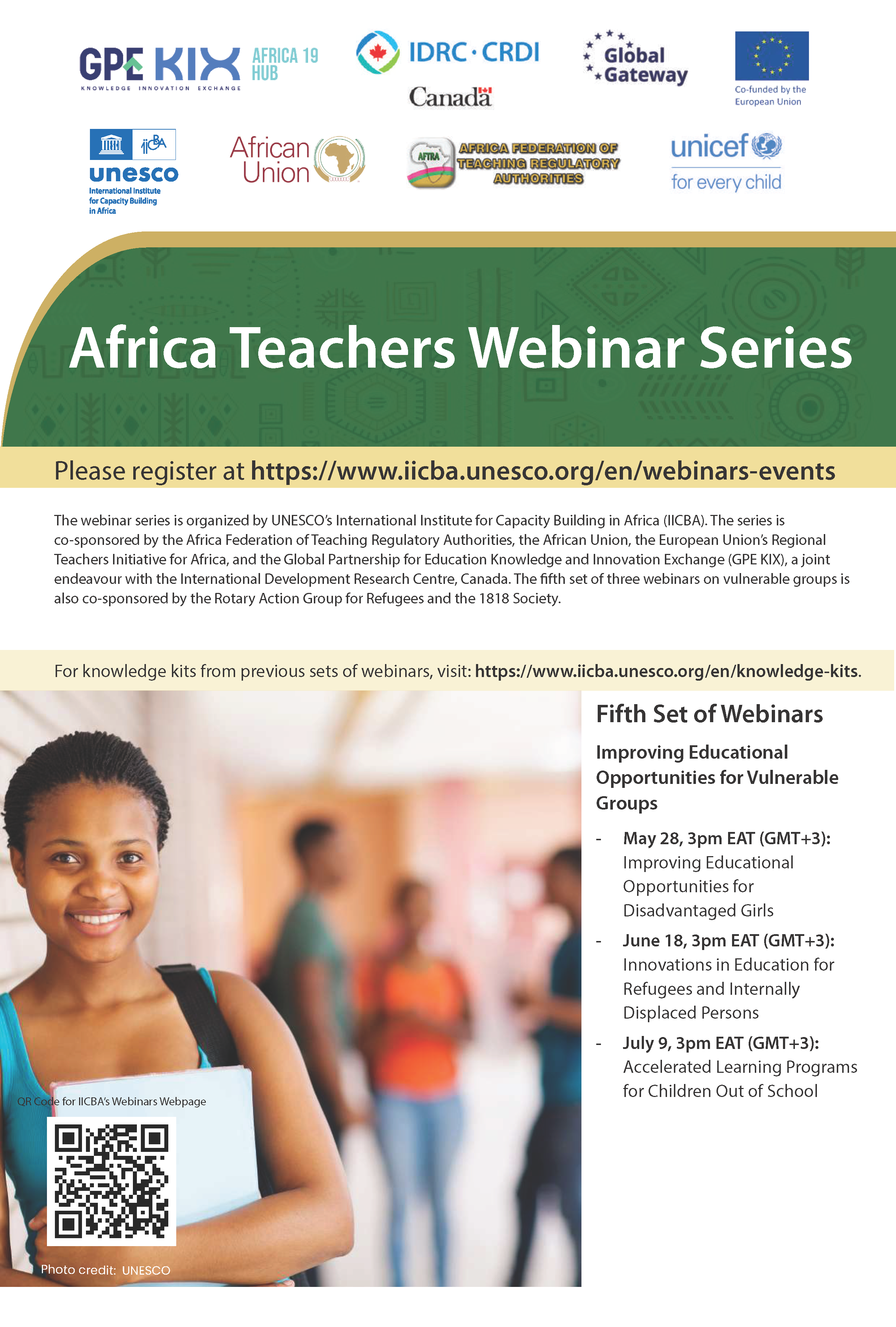
Africa Teachers Webinar Series

The series is co-sponsored by the Africa Federation of Teaching Regulatory Authorities, the African Union, the European Union’s Regional Teachers Initiative for Africa, and the Global Partnership for Education’s Knowledge and Innovation Exchange, a joint endeavor with the International Development Research Centre. The webinar series is organized by UNESCO’s International Institute for Capacity Building in Africa, which leads the GPE KIX Africa 19 Hub and is a partner in the European Union’s Regional Teachers Initiative for Africa.

Leveraging Technology for Teacher Professional Development

Thursday, 13th March 2025, 3 PM East African Time (GMT+3)

Objectives:

  • Explore innovative ways to use technology in Continuous Professional Development (CPD) for teachers.
  • Learn from experts from UNESCO, EdTech Hub, South African Council for Educators, and leading institutions across Africa!
  • Attend all three webinars and earn a digital certificate of participation

Key speakers:

  • Hannah Simmons, Tanzania Country Lead, EdTech Hub, EU RTIA grantee
  • Dr. Shafika Isaacs, Chief of Section, Technology and AI, UNESCO Headquarters, Paris, France
  • Prof Nkobi Pansiri, Head of Department, University of Botswana & Consultant to South African Council for Educators (SACE)
  •  Associate Prof Gabriel Job, Head, Educational Technology Department, National Open University of Nigeria
  • Dr. Lekopanye Lacic Tladi, Senior Lecturer, Botswana Open University
  • Prof. Steve Nwokeocha, University of Calabar, Nigeria & AFTRA

Links: 

Event
  • 25.02.2025

Designing and Implementing Effective CPD Programs for Teachers

Africa Teachers Webinar Series

The series is co-sponsored by the Africa Federation of Teaching Regulatory Authorities, the African Union, the European Union’s Regional Teacher Initiative for Africa, and the Global Partnership for Education’s Knowledge and Innovation Exchange, a joint endeavor with the International Development Research Centre. The webinar series is organized by UNESCO’s International Institute for Capacity Building in Africa, which leads the GPE KIX Africa 19 Hub and is a partner in the European Union’s Regional Teacher Initiative for Africa.

Designing and Implementing Effective Continuous Professional Development Programs for Teachers

Thursday, February 27, 2025, 3 PM East African Time (GMT+3)

Key Speakers:

  • Dr. Ebby Mubanga, Deputy President, AFTRA & Registrar, Teaching Council of Zambia
  • Dr. Victoria Kisaakye Kanobe, Senior Project Coordinator, UNESCO IICBA
  •  Prof. Betty Ezati, Chairperson of Taskforce, Uganda National Institute for Teacher Education
  • Dr. Astérie Nyirahabimana, Assistant Lecturer, University of Rwanda, Kigali
  • Dr. Christian Addai Poku, Registrar of the National Teaching Council, Ghana

Links: