This blog has been co-authored by Maryann J. Dreas-Shaikha and Quentin Wodon from the UNESCO UNESCO’s International Institute for Capacity Building in Africa (IICBA).
Pre-service education for teachers is key to improve teaching and learning in Africa. To share good practices on pre-service education in Africa, UNESCO’s International Institute for Capacity Building in Africa (IICBA) implemented a virtual Community of Practice (CoP) in the second half of 2025. This post outlines a few lessons learned.
A space for peer learning across countries
The aim of the CoP was to promote an exchange of ideas and policies, frameworks, and evidence-proven practices in teacher education. The CoP was open to regional experts, practitioners, and policy actors who were interested in joining a peer exchange platform to deepen their understanding of teacher education in Africa and enhance their capacity to contribute to reform efforts in their own country or organization. While originally envisioned as a platform for government officers and teacher educators, the CoP was expanded to admit school leaders and head teachers, which provided rich context on the experiences of teachers and their professional development needs.
The CoP was organized by IICBA with funding and facilitation from the Global Partnership for Education’s Knowledge and Innovation Exchange (GPE KIX) Africa 19 Hub, a joint project with the International Development Research Centre (IDRC) of Canada. Partners included the European Union’s Regional Teachers Initiative for Africa (EU-RTIA), the Shanghai Funds-in-Trust, the Africa Federation of Teaching Regulatory Authorities (AFTRA), and the African Union’s Education, Science, Technology, and Innovation Department. The CoP ran from July to December 2025.
A variety of key themes explored by the participants
Topics to be covered were selected through a consultative process especially between IICBA and EU-RTIA as the two main sponsors. Focal points from GPE partner countries also influenced the selection of topics through their responses on a prior Knowledge and Innovation Exchange (KIX) Africa 19 Hub country survey facilitated by IICBA which hosts the secretariat of the Hub. Based on this process, topics chosen for discussion included: (i) Dimensions of effective teacher education and development programs; (ii) Regional guidance on teacher competencies and teaching standards; (iii) Challenges faced by new teachers, teacher educators, and teacher training institutions (TTIs) due to gaps in teacher education curriculum and implementation; (iv) Reforms and innovations in pre-service teacher education; and (v) Digital skills integration in pre-service teacher education.
What the CoP revealed about virtual professional learning
Providing time for open discussions is key
The CoP was designed as an online professional learning course with conceptual presentations by experts, experience sharing by national representatives, discussions, and regular, though voluntary, assignments. The aim was to encourage participant discussions directed by facilitators’ questions using a variety of virtual tools for peer-to-peer sharing about challenges, current reform efforts, national aspirations, and participants’ experiences. Ten virtual synchronous workshops were held on Zoom, each lasting at least two hours (and on occasion up to three hours). Each session featured speakers from IICBA and co-organizers, especially AFTRA and the EU-RTIA. A question-and-answer session between the speakers, facilitators, and participants followed each presentation. Then, a learning activity and plenary allowed participants to delve more deeply into the content shared. The sessions were supplemented by asynchronous discussion boards on Google Classroom and WhatsApp. This overall setting was appreciated by participants, but some suggested that having even more time for open discussions, and therefore a less packed agenda for each session, would be beneficial.
Continued participation varies between groups
The CoP had 163 participants who logged in a total of 639 times across sessions from July to December 2025. Participants were almost evenly split between men and women. A total of 29 participants joined all sessions and completed the voluntary course assignments and other requirements to earn certificates of completion. Participants came from 22 countries and could be characterized as belonging to four groups: (1) Policy makers and ministry leadership; (2) Academics and teacher educators; (3) Staff from non-governmental and regulatory bodies; and (4) School leaders and practitioners. Analysis of participation over time reveals attrition over the six months, with high initial participation tapering off mid-course with a committed group that completed finished the course and submitted assignments. Attrition is common in virtual voluntary spaces targeting senior officers and working professionals, especially when the time commitment and workload build up. Attrition was highest among the first group of participants mentioned above (senior officials).
Regular participants tend to be the most satisfied
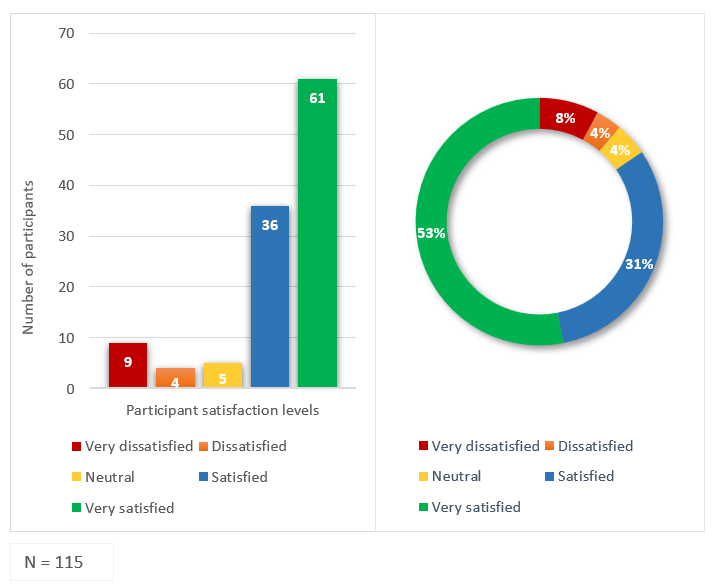
Short satisfaction surveys were implemented after the sessions to which 115 participants responded. As shown in the Figure below, a great majority (84 percent) of participants expressed satisfaction with the course, with 53 percent saying they were very satisfied and 31 percent satisfied with the content and platform. A small percentage (4 percent) were not sure, and 12 percent were not satisfied, mostly due to the fast pace of delivery, a high number of presentations that educed time for discussion, and challenges with technology. As expected, participants who joined most sessions experienced and expressed greater satisfaction with the CoP (conversely, high satisfaction was probably one of the factors leading to the strong presence of some participants).
Participants’ satisfaction with the CoP
Assignments for certificates of completion are helpful
Participants were encouraged to complete weekly readings of articles, case studies, and other resources and submit short essays and reflections prior to each session. Participants were also required to submit a long-term assignment to earn a certificate of completion. Assignment options included: (i) Writing a case study paper about the state of pre-service teacher education in their country; (ii) Interviewing teacher educators and/or novice teachers in their country; (iii) Creating and implementing a professional action plan to apply their learning in their departments; and/or (iv) Assessing their country’s teacher education system using a matrix with delineated dimensions of pre-service teacher education and assigned indicators (that matrix was provided by IICBA). Thess assignments proved useful to ensure deeper learning and participation and participants were excited that selected papers they wrote will be published in a special issue of the Journal of Teaching and Learning in Africa of the Africa Federation of Teaching Regulatory Authorities.
Encouraging results and lessons for future CoPs
Continuous professional development for teachers is key to improve learning outcome in Africa. This must start with quality pre-service education. Unfortunately, pre-service education is often ineffective, outdated, and misaligned with teaching realities and the need to upgrade teacher skills in Africa. In addition, evidence on what works tends to be poorly disseminated and underutilized in the design and delivery of programs and curricula. IICBA’s CoP launched in July 2025 aimed to respond to some of those challenges. It had a total of 163 participants from 22 anglophone countries, although only 29 completed all the assignments to receive a certificate of completion. Satisfaction rates among participants were high and participants who completed all assignments submitted work of quality. These findings are encouraging. At the same time, improvements could be made, such as ensuring sufficient time for discussion and helping some participants understand better the technology used in online meetings. Building on this experience, a second module for the CoP will start mid-2026 focusing on in-service professional development.
Resources
- African Teacher Qualification Framework
- UNESCO IICBA Strategic Plan Update 2026-2028
- African Union’s Education Strategy CESA 2026-2035
- Journal of Teaching and Learning in Africa (AFTRA–UNESCO IICBA)
- Teacher Support and Motivation Framework for Africa
- GPE KIX Africa 19 Hub – Community of Practice on Teacher Education Reform
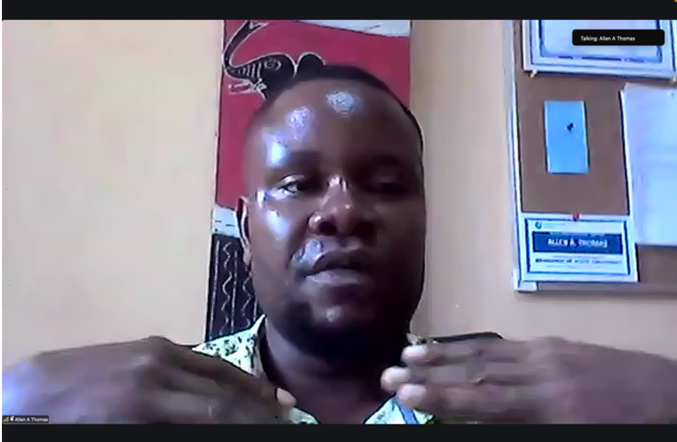
Hero photo: Mr. Allen Thomas, Physics teacher from Liberia and a winner of the 2025 African Union Continental Teacher Awards instructs his students in rural Liberia. Photo credit: UNESCO IICBA.