Teacher support and motivation framework for Africa: emerging patterns
Teacher allocation and utilization in Africa
La Question enseignante au Bénin : un diagnostic holistique pour la construction d'une politique enseignante consensuelle, soutenable et durable
How the COVID-19 pandemic is affecting contract teachers in sub-Saharan Africa
Based on research provided by Pierre Varly for the TTF, this note examines how COVID-19 is affecting contract teachers in the public and private sectors in several African countries and provides recommendations for improving education resilience in the face of school closures. It has been published to mark the release of the TTF Review of the use of contract teachers in sub-Saharan Africa.
The current global education crisis
The COVID-19 pandemic has had an unprecedented impact on education systems. At its height, 194 countries had implemented country-wide school closures, affecting 63 million primary and secondary teachers. Sub-Saharan Africa has not been spared during this crisis, witnessing country-wide closures affecting an estimated 6.4 million teachers.
Who are contract teachers?
Contract teachers are recruited through alternative pathways and agree to work outside traditional employment arrangements that are supported by a civil service collective agreement. They receive a salary for the work they perform but do not receive the benefits that apply under public-sector norms and standards, such as annual leave, pension or health insurance.
While contract teachers may hold similar academic qualifications to their civil service colleagues, they are frequently trained insufficiently in pedagogy, and do not participate in continuous professional development programmes. As a result of their status, contract teachers typically receive lower remuneration and have less job stability, as their employment is subject to public budget fluctuations, market pressures and education providers’ ability to pay.
In practice, there is no single definition of a contract teacher. In francophone sub-Saharan Africa, for example, the terms part-time teacher, state contract teacher, community teacher, national service contract teacher and volunteer all refer to contract teacher subtypes. Teachers in the private sector may also be thought of as contract teachers since they are often paid directly by schools through fees collected from parents. They typically earn less than their public sector counterparts. Various public-private arrangements also exist, with varying implications for the payment of salaries.
Contract teachers as means to expand access to education
The world will need an estimated 69 million teachers, including 17 million for sub-Saharan Africa alone, to meet the fourth Sustainable Development Goal (“Ensure inclusive and equitable quality education and promote lifelong learning opportunities for all”) in 2030. Due to the teacher shortage in many government-owned schools, contract teachers have been used by the public sector to fill gaps, especially in several sub-Saharan African countries, where the school-age population has grown faster than countries’ capacity to train them. In other countries, remote and rural community-based schools have been set up, based on a public-private model, that employ teachers paid for by local communities and/or through government subsidies.
Understanding the impact of the COVID-19 pandemic on contract teachers is essential as they represent a high proportion of the teacher workforce in many countries. They represented 71% of all pre-primary to secondary level teachers in Niger in 2017, according to RESEN, while 64% of primary teachers in Chad were contracted community teachers in 2014. Contract teachers increased as a proportion of all teachers in primary education in Burkina Faso from being negligible in 2002 to 81% in 2015. In contrast, contract teachers decreased as a proportion of the workforce in Mali from 79% in 2009 to 29% in 2014 – as a result of a government decision under pressure from teacher unions to grant civil service status to more than 40,000 contract and community teachers.
Delayed payments and other impacts on public sector contract teachers
COVID-19 has had varying impacts on the employment and salaries of public sector contract teachers. Public sector contract teacher contracts in Cameroon, Niger and Zambia have not been suspended. Moreover, contract teachers have received their salary payments regularly despite school closures.
This contrasts with Togo where “volunteer” contracts are held by 27% of primary, 41% of lower secondary and 25% of upper secondary teachers. While teachers’ contracts have not been suspended or terminated, regular salary payments have been a challenge. At the end of May 2020, the National Agency for Volunteering (ANVT) regularly paid about 900 contract teachers, but another 9,490 had not received any state support, representing about 1 in 6 teachers in Togo.
Some evidence shows that in Kenya, contract teachers also did not receive their salaries, since payments depend on school management, which was not possible during school closures. The joint UNESCO/UNICEF/World Bank survey of country responses shows that Burkina Faso and Guinea will also suspend payments to contract teachers, while Ghana and Sierra Leone will continue to pay salaries but after applying reductions. According to the secretary-general of the Teachers’ Union in Uganda, Filbert Baguma, contract teachers there, too, have not received regular salary payments.
Although their situation is not directly related to COVID-19, 2,500 new teachers hired in late 2019 in Niger have yet to receive salary payments for the first few months of 2020. Having incurred debts to travel to their postings, teachers were then obliged to leave their posts during the shutdown then return for the reopening of schools on 1 June (Education International, 2020). In Cote d’Ivoire, the Ministry of National Education, Technical Education and Vocational Training announced that payments would soon be made to 10,300 teachers recruited in 2019.
In Gambia, temporary teachers whose contracts ended in March 2020 were unable to reapply for their positions due to school closures, ending their regular income.
Private sector teacher instability
COVID-19 has revealed institutional shortcomings in the management of teachers. For the public and especially for the private sector, contract teachers may not be covered by any regulations in the event of force majeure (a circumstance beyond the control of both parties). Unlike in the public sector, however, private sector teachers receive salaries directly from school providers, making the tracking of payments much more difficult. In other cases, including community schools, a public-private model is used where local parents pay fees to the school, which can in turn be subsidized by central education authorities, to cover costs such as salaries.
Information from surveyed countries suggests many private sector teachers were not paid for April and May, mostly because shuttered schools were not able to recover all tuition fees, which constitute their only source of income. The situation varies between schools, however, depending on their capacity to offer distance or online instruction. In other cases, wages are tied directly to the work teachers do, so teachers are not paid during closures and absences. In rural community schools, implications for payments are less clear since salaries can be comprised of fees paid by parents and government subsidies, or direct payment to teachers.
According to Stéphane De Souza, the general coordinator of the provisional office of private teachers in Togo, teachers have had no salary updates from their employers (Kossi, 2020). The National Director of Catholic Education also suspended salaries of teachers for May and June. To improve matters, the Ministry of Primary and Secondary Education indicated volunteer teachers will receive government assistance throughout closures (Togolese Republic, 2020); to date, however, volunteer teachers have not received assistance. Similarly, private sector teachers have not been paid in the Democratic Republic of the Congo, Niger and Senegal, while in Kenya many teachers’ contracts have been suspended due to a general lack of resources.
To maintain partial salaries for private school teachers in Mozambique, the government has requested that private school leaders negotiate with staff and that parents continue to pay monthly fees. Some parents have not complied, making it difficult for administrators to pay full salaries to teachers. As a result, some schools have negotiated with teachers to lower salaries to 75% during the first month and 50% during the second. Similar reports from Zambia show that many private sector teachers there are currently receiving 50% of their monthly salaries.
Finally, it is important to note that since a significant portion of the early childhood care and pre-primary education sector is private, the implications for pre-primary teachers’ salaries not being paid will be greater than in primary education. Additionally, since 80% of pre-primary teachers in sub-Saharan Africa were female in 2017, the non-payment of salaries at this level primarily affects women.
Towards a more effective response for covering salary costs and building system resiliency
As the main system input to achieving education quality, teachers need to be sufficiently trained and supported. The non-payment of teacher salaries therefore not only poses a significant problem for individual, family and community well-being, but also prevents the delivery of quality education and the achievement of SDG4. The effects on teachers of school closures, including attrition and the hardship experienced by those returning, could seriously harm teaching and learning, and undermines the education system’s ability to withstand shocks, including possible resurgences of COVID-19 when schools reopen.
The non-payment of salaries also places a psychological burden on teachers. The General Coordinator of the Provisional Office of Private Teachers in Togo uttered a cry of despair: “We have nothing left to provide for our families. The situation is serious.” (Kossi, 2020).
Government can show leadership by mitigating some of the most severe impacts. Senegal, for example, set up a contingency fund called Force COVID-19. This response fund of 1,000 billion FCFA (USD 1.6 billion) is intended to support businesses and households through a social and economic resilience programme (PRSE) that guarantees wages, including those of both civil servants and contract staff working in public institutions, until classes reopen.
For the private sector, governments can influence private providers in the regular payment of salaries. Education authorities in Cote d’Ivoire have used traditional and social media networks to communicate the importance of paying private sector salaries. The minister of education even warned the private sector against teacher layoffs and non-payment of salaries while congratulating those that continued to meet payments. The minister went further to stress that the payment of salaries by private providers will be a precondition to the transfer of funds to private sector establishments.
Civil society teacher representatives can also continue to play an important role. This includes both public sector teacher unions and those representing the interests and rights of private sector teachers. Due to non-payment to private sector teachers in Togo, a new teacher union was quickly set up, the National Union of Private Schools and Institutions of Togo (SYNEP-TOGO), which held its constituent general assembly in April 2020. Formed to defend private teachers’ rights and socio-economic interests, SYNEP-TOGO aims to ensure better representation of its membership to public authorities and international organizations to allow for collective bargaining for the private sector (Togo top news, 2020).
Recommendations for maintaining teachers’ contracts and payment of salaries
Member states are reminded of the 1966 ILO/UNESCO Recommendation concerning the Status of Teachers and articles about teachers’ salaries, and rights and responsibilities. The Teacher Task Force further proposes the following recommendations to ensure teacher salaries are covered now and during future school closures.
Enhance the provision of distance education: The spread of distance education is vital for the continuation of teaching and learning during school closures; however, it is also vital to maintain teacher contracts. Where schools close and teaching and learning cannot be transferred online or through other distance education methodologies (including via mobile phones, broadcast and Interactive radio and television and printed materials), contract teachers will be vulnerable. A partial solution is to develop strategies that help schools and teachers to continue teaching during school closures, including the use of high-, low-, and no-tech solutions. For this, teachers need to receive adequate training and preparation, with special provisions for contract teachers who are excluded from professional development opportunities. They also need access to the Internet and the necessary devices.
Develop financing strategies to cover teacher salaries: The Global Partnership for Education (GPE) has announced an additional USD 500 million to support education systems affected by COVID-19 school closures. Governments therefore may have additional leverage to pledge special funding of up to about 4% of total education expenditures to ensure that all teacher salaries – public and private – are paid during short periods of crises. Governments can also make subsidies to private schools conditional on the payment of teachers’ salaries. Countries should also consider innovative funding mechanisms to support teachers during the crisis and the international community should be able to support these efforts.
Strengthen teachers’ voices through teacher unions and civil society representation: Public and private sector teachers – including teachers and support staff in early childhood care and pre-primary education – need better representation. At the same time, relationships between teachers’ unions need to be strengthened to enhance sharing of information related to COVID-19, its impact and effective ways to maintain learning, including distance learning techniques. The collective representation of education support staff and early childhood care and pre-primary education staff needs to be enhanced to improve their standing.
Improve communication with parents, caregivers and communities: Governments can communicate better with parents and caregivers about school closures and their impact on education, as well as with communities about the importance of paying school fees on time, despite the interruption in education, to ensure teachers do not lose their livelihoods.
Improve data on non-civil servant teachers: It is important to collect regular data on contract teachers, including their salaries, training, qualifications and conditions of employment, to enable more effective policy and planning responses when needed.
**********************************************************
Teacher Task Force presents new research on the impact of COVID-19 on contract teachers
To shed light on the impacts of the COVID-19 crisis on contract teachers in sub-Saharan Africa, the Teacher Task Force conducted desk research and numerous interviews with representatives of ministries, trade union and UNESCO National Commissions. The research is supplemented by data collected through the joint UNESCO/UNICEF/World Bank “Survey on National Education Responses to COVID-19 School Closures.” The Teacher Task Force is also publishing the “Review on the use of contract teachers in sub-Saharan Africa”, which takes a closer look at the situation of contract teachers in 23 countries in sub-Saharan Africa.
The Teacher Task Force, in its response to the COVID-19 crisis, issued a Call for Action on Teachers to ensure all teachers are protected, supported and recognised. In it, the Teacher Task Force calls on governments, education providers and funders – public and private – and all relevant partners to preserve employment and wages, stressing that governments and all public and private education providers should work to preserve the entire teaching and education support staff, and their salaries and benefits. They will be essential for a rapid and effective recovery when schools re-open.
Blog's photo credits: Dietmar Temps / Shutterstock.com
Strengthening School Leadership and Governance amidst and post the Covid19 Crisis in Africa
With the advent of the COVID19 pandemic there has been a lot of school disruption. As the COVID-19 crisis deepens and spreads, a strong response by school leaders is urgently needed to mitigate against the disruption faced by children who may be out of school for the foreseeable future. School leaders are uniquely positioned to have the respect and personal relationships to guide families on how to support their children at home during this unprecedented, fast-moving challenge.
This webinar, organized by UNESCO IICBA, seeks to create an opportunity for education experts to collectively reflect on how school leadership and governance can be enhanced to address the current unpredictable education sector challenges posed by the coronavirus pandemic and during the school re-opening process.The webinar seeks to create an opportunity for education experts to collectively reflect on how school leadership and governance can be enhanced to address the current unpredictable education sector challenges posed by the coronavirus pandemic and during the school re-opening process.
The objectives of the webinar include the following:
- Provide a platform to reflect on the role of school leadership and management in ensuring continuity of teaching and learning amidst the COVID19 pandemic;
- Discuss the current challenges school leaders have faced in creating linkages with the learners, the teachers, their communities amidst the COVID19 pandemic;
- Discuss the key ingredients and innovative strategies needed to build resilient school leaders and managers that can ably support those mostly in need; and
- Deliberate on the various strategies to improve the efficiency and effectiveness of School Leadership and Governance at the national level, to better respond to the emerging education needs and challenges in the region amidst the current Covid19, during school reopening and post the pandemic.
Follow the link below to join:
Microsoft Teams: https://tinyurl.com/ydytt7f2
School safety manual: tools for teachers
No electricity, no Internet, no online learning: Lara’s story
Shanghai, January 2020
I woke up one morning in the Chinese New Year holidays to find we were not going to return to school on February 3 as expected. Instead, we were told to prepare to teach online. As the pandemic spreads all over the world education has to reinvent itself rapidly. Teachers from all over the world have come together on social media to support each other and share experiences during these difficult times. But as I become more conversant with online teaching, my mind is still not at ease. I am one of the privileged ones lucky enough to have access to a huge number of resources. But how about those who are not so lucky? My thoughts were with the people in my home country, Mozambique, and other developing countries where the vast majority of the population has no access to electricity, let alone online learning.
Lara, a 13-year-old eighth grader, starts her day by helping the family with chores around the shack where they live instead of heading to school as she used to do before the terrifying pandemic. Lara and her family live in Manhiça, in the province of Maputo, Mozambique. She attends the Filipe Nyussi School in Maluana. Neither of Lara’s parents has completed primary education. Her father is the sole income provider and he earns about $45 per month, which he needs to manage carefully between food for the family and education for Lara and her seven brothers and sisters.
Despite the difficulties, Lara’s father says his dream is to see his daughter complete her education. He beams with pride as he describes Lara as a smart, passionate, and dedicated student. Sadly, he also expresses a lot of concern about the uncertain future.
Due to the pandemic, schools in Mozambique have closed. Lara’s daily routine has changed dramatically. She must stay at home while her father walks to school to collect school assignments. When he gets home after work, Lara completes the assignments and later submits them for the teachers to review and grade. Occasionally, her father has had to pick up assignments twice, paying up to 160 meticais (about USD 2.40).
Lara is very eager to learn. She is frustrated that while she would spend four hours a day learning when she could go to school, her current routine only allows her to study for one hour a day. The family agrees that the current level of education is extremely weak, but unfortunately there is little they can do. They complain about the additional costs for the printed material.
Lara and her family have no access to electricity and consequently have no TV or Internet access at home. This type of situation is very common throughout the country. For this reason, schools have resorted to providing written material prepared by the teachers for students to study at home. Many other children in rural areas, especially girls, face similar challenges. While school is meant to be free, many have complained about the fees for the printed material. In addition, not going to school exposes young girls like Lara to hidden risks of premature marriages and/or pregnancies.
Private schools in urban areas are investing in online schooling for their pupils. However, the level of investment is not standardized and not consistent among schools. Some private schools are moving faster with online platforms and online classes to better meet the needs of their students. Nevertheless, they also rely on parents’ willingness or financial ability to invest in access to technology such as Internet connectivity, computers, and mobile devices.
Studies have shown that the quality of education in Mozambique lags behind that of its neighboring countries and the level of school retention for young girls in the country is still a challenge. On top of that, the country also struggles to provide proper training for its teachers.
Online education is not a feasible option in a country where most people have no access to the Internet. While teachers from all over the world get together in social media to collaborate and give education a face-lift, some teachers and schools in less privileged countries are forgotten.
Nadya Faquir
**********************************************************
This piece is part of the Teacher Task Force’s #TeachersVoices campaign, created to bring forward the experiences of teachers working every day to ensure their students continue to benefit from a quality education despite the COVID-19 pandemic. To participate, go to our dedicated webpage.
Regional Virtual Meeting for Anglophone sub-Saharan Africa
COVID-19 education crisis - Supporting teachers on school reopening strategies and distance education
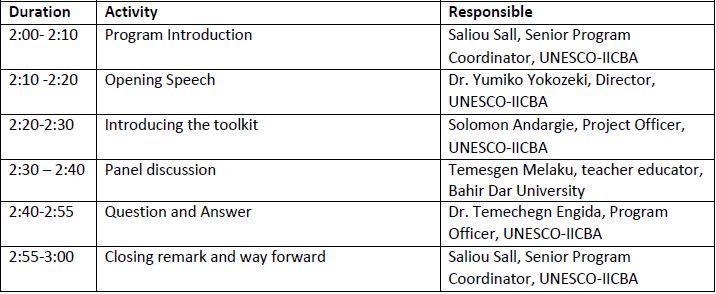
The Teacher Task Force Secretariat (TTF) is organizing a virtual regional meeting in collaboration with the UNESCO International Institute for Capacity Building in Africa (IICBA) on 28 May 2020, at 14.00 (Addis time/GMT+3hrs).
The aim of the session will be to bring together countries and relevant regional stakeholders to discuss the challenges, needs, opportunities and potential solutions related to teachers to inform coherent national and regional responses to support teachers, the teaching profession and identify solutions to mitigate help teachers adapt to their changing roles during and after the global COVID-19 crisis.
In particular, the objectives of the meeting are:
- to understand the challenges faced by countries in addressing issues related to teachers and teaching while designing education responses to COVID-19;
- to share potential practices to support teachers, including training and psycho-social support;
- to highlight challenges and opportunities in the reopening of schools.
This meeting is part of a series of several regional virtual meetings with national and regional education stakeholders to inform responses related to teachers, nationally, regionally and globally. Attached with this message you will find a concept note for the meeting which will be conducted online using a webinar platform.
Teaching through COVID-19 in South Africa - #TeachersVoices
Your experience as a teacher using distance teaching / learning tools and platforms?
Before Covid 19, I used Skype in the classroom as a tool for long distance teaching. I had involved teachers around the world in my classes and had contributed to international classes as well. When our school was preparing to close due to Covid 19, we were already using Microsoft TEAMS and Google Classroom at school. When school closed, we were asked to use these for online teaching, and setting and grading of assignments.
How you are working with students and colleagues to continue providing education despite the crisis?
The two platforms, Microsoft TEAMS and Google Classroom, have proved excellent for online teaching. I give (and record) lessons with up to 30 pupils in a class at a time, and take questions so the class is interactive. I also set up WhatsApp groups for each of my classes, for quick messages and to receive questions. I also send short voice messages, either reminding pupils of something that is due or send short messages of support. I have uploaded Kahn academy clips, YouTube clips, or links to lessons that I put on Google classroom, and have assigned work with deadlines here too.
Pupils that are from under-resourced backgrounds were provided with a dongle and data by the school, and an iPad, to ensure they can keep up with lessons.
How you are dealing with these new working conditions?
The pupils have responded differently, and I have therefore had to adjust my teaching for those who go at a slower pace, due to lack of self-discipline or depression due to isolation. I start each lesson with emotional encouragement, get feedback on how people are feeling, and generally have slowed my pace or expectations. Some pupils work fast, but some have slowed down, due to family members being diagnosed positive with the virus, or other personal reasons. I find the parents are also challenged with everyone being at home and are asking the school to have a day each week when pupils can catch up and no new work is assigned. In some of the lessons, when I say goodbye, the pupils get quite tearful. They are really trying hard to keep up with the work. I have been very proud of them but realise how much explanation and support they rely on, day to day. I have tried to keep it simple as pupils are having a lot of online lessons. They are logging off and on to different teachers’ lessons for 5 hours, with few breaks. This is a senior school, but some teachers have not stuck to the timetable, and thus their tests have gone over-time etc.
Some of the important activities that I run, such as social responsibility, where we work with inner city kids who have AIDS, and “Model UN” that I run, and the work I do with other organisations on SDGs, has slowed down and much has been put on hold for the 21 days of complete shut-down.
What guidelines and support have you been given (if any)?
We have support from our IT staff, online. Staff members share information on what apps and programmes have worked for them. Staff are asked to stick to the normal timetable for lessons and we are preparing online reports as well at the moment. We share glitches with IT who then try and solve them.
In early April, I was asked to be part of a Jakes Gerwel Fellowship Webinar in South Africa, called Educating in Interesting Times, which addressed the use of different tools for online education.
I am also on the Varkey Foundation’s Varkey Teacher Ambassador (VTA) network and share and receive ideas there.
Marjorie Brown
Marjorie Brown was one of the finalists of the Varkey Foundation's Global Teacher Prize.
**********************************************************
This piece is part of the Teacher Task Force’s #TeachersVoices campaign, created to bring forward the experiences of teachers working every day to ensure their students continue to benefit from a quality education despite the COVID-19 pandemic. To participate, go to our dedicated webpage.