Event
  • 24.06.2021

The best investment – Supporting teachers in COVID-19 recovery and beyond

Watch the replay here.

Ensuring qualified and motivated teachers in every classroom is the single-most important school-based determinant of quality education and learning outcomes. However, around the world, not only are there not enough teachers, but large numbers have not received sufficient training and lack minimum qualifications. The COVID-19 crisis also shone the light on the need for sustained and increased domestic and international financing and investment in teachers and teaching as the basis of education systems. Teachers must be better prepared to ensure that a generation of learners is not lost.

The side event will present new findings from research carried out by the Teacher Task Force addressing the following questions:

  • How can we identify and tackle the persistent and unresolved global teacher shortages which are jeopardising the future of millions of learners, in particular the most disadvantaged?
  • How much is needed to support teachers in the aftermath of the crisis, in particular in training in ICTs and blended learning, remedial learning as well as to support teachers’ safety and well-being?
  • How to create space in domestic budgets, as well as leverage international funds to support quality teaching, including addressing questions such as teacher motivation, career progression and retention?

Read the concept note.

***

This event is organized on the sidelines of the Global Education Summit: Financing GPE 2021-2025 in the framework of the Teacher Task Force #InvestInTeachers campaign.

English, French and Spanish interpretation will be provided.

Register here: https://unesco-org.zoom.us/meeting/register/tJ0kcuitrD4vGNNKdYt3tvuShdYXBW8hib1K

Blog
  • 23.04.2026

Low-tech, high impact: training teachers where they are

This blog has been co-authored by Prof. Sarah Younie, CEO, MESHGuides, and April Williamson, Director of Global Projects, Digital Promise, co-leads of the Teacher Task Force Thematic Group on Digital Education and Artificial Intelligence.


Teachers are at the heart of every education system, but in many parts of the world, they lack access to quality training and professional development. According to UNESCO and the Teacher Task Force, an estimated 44 million new teachers will be needed by 2030 to achieve the SDG 4 targets. Addressing this global teacher shortage requires a holistic approach, including training and accreditation systems that build professionalism and effectively support and develop teachers throughout their careers. Yet in many contexts — particularly those affected by crisis, limited infrastructure, and scarce resources — conventional training models fail to reach those who need them most.

The COVID-19 pandemic further highlighted the urgent need to equip large numbers of teachers with both foundational and 21st-century skills that are critical for lifelong learning and resilient societies. Teachers must be qualified, supported, and motivated — not only to provide quality teaching today, but also to prepare students for inclusive and increasingly digital societies. This is especially urgent in low- and middle-income countries, where scalable, low-cost, and rapidly deployable solutions are needed to meet the need for large-scale, high-quality, and effective training.

In this context, low-tech and mobile approaches — such as messenger-based training — are proving to be both relevant and cost-effective. Designed to function on basic phones with minimal bandwidth, these tools offer flexible, scalable, and accessible learning opportunities that meet teachers where they are. By leveraging tools that are already used by teachers, low-tech solutions can minimize, and even reduce, workload.

A number of members of the International Task Force on Teachers for Education 2030 (Teacher Task Force, or TTF) have been at the forefront of implementing such approaches. The TTF Thematic Group on Digital Education and AI, co-led by MeshGuides and Digital Promise, hosted a webinar, “Low-Tech, High Impact: Training Teachers Where They Are”, to highlight perspectives and lessons learned from two of these scalable, mobile-based teacher training solutions: the Future Teacher Kit and ProFuturo.


Mobile-based Teacher Training: Future Teacher Kit 

The Future Teacher Kit (FTK) is a mobile-based training approach tailored to reach teachers in a range of settings, including remote and crisis-affected areas. On behalf of the German Federal Ministry for Economic Cooperation and Development (BMZ), GIZ (Deutsche Gesellschaft für Internationale Zusammenarbeit) developed the Future Teacher Kit in collaboration with UNESCO and more than 1,500 teachers. The webinar highlighted perspectives on FTK implementation and impact from the Ministry of Education of Ecuador and the Jamaica Teaching Council, as well as GIZ, UNICEF and UNESCO.
 

“We know today that education systems owe teachers – not the other way around.” - Eilean von Lautz-Cauzanet, GIZ


The FTK is an adaptive, scalable professional development solution designed to prepare educators for a rapidly evolving educational landscape by improving access, fostering communities of practice, and supporting education system resilience. It uses low-tech tools with high impact, such as messenger services, to reach teachers in low-connectivity areas. Through ambassador-led, participatory communities of practice, it promotes collaboration, intrinsic motivation, and self-paced learning, while strengthening teacher networks and institutional capacity. 
 

FTK
 Key characteristics of the Future Teacher Kit’s approach to ensuring scalable, accessible, and impactful teacher training.


UNICEF joined the FTK partnership in 2024, contributing its strong expertise in digital teacher development. UNICEF has developed the Superstar Teacher Toolbox, a tool to support educators to use mobile messaging for learning, including two practical guides on digital skills and mobile pedagogy. Its content has been integrated into the FTK, leveraging the UNICEF RapidPro platform for text-based delivery. This partnership is enhancing the FTK’s scalability and pedagogical quality. 
 

“The Future Teacher Kit reignited my love for teaching. It reminded me that I could grow, even in a digital world. It wasn't just training—it was transformation.” - FTK Cohort Participant 


Competency-based Digital Skills Training: ProFuturo 

As a leader in digital teacher training, ProFuturo shared complementary experiences and practical lessons from their work in low-resource contexts. ProFuturo is an education innovation programme based on technology, founded in 2016 by Telefonica Foundation and “La Caixa” Foundation. 

Learning and teaching are two essential processes in today’s society. To address them holistically, ProFuturo has developed the Global Framework for Educational Competence in the Digital Era. This framework supports lifelong learning, especially for teachers, and invites the educational community to reflect on the meaning of learning and teaching in the digital age, and on the teacher’s pivotal role in both. Their teacher training approach is based on an ongoing competence cycle that involves:

  1. Measurement to understand teachers’ competences, through tools like the Self-Assessment of Digital Skills for Teachers.
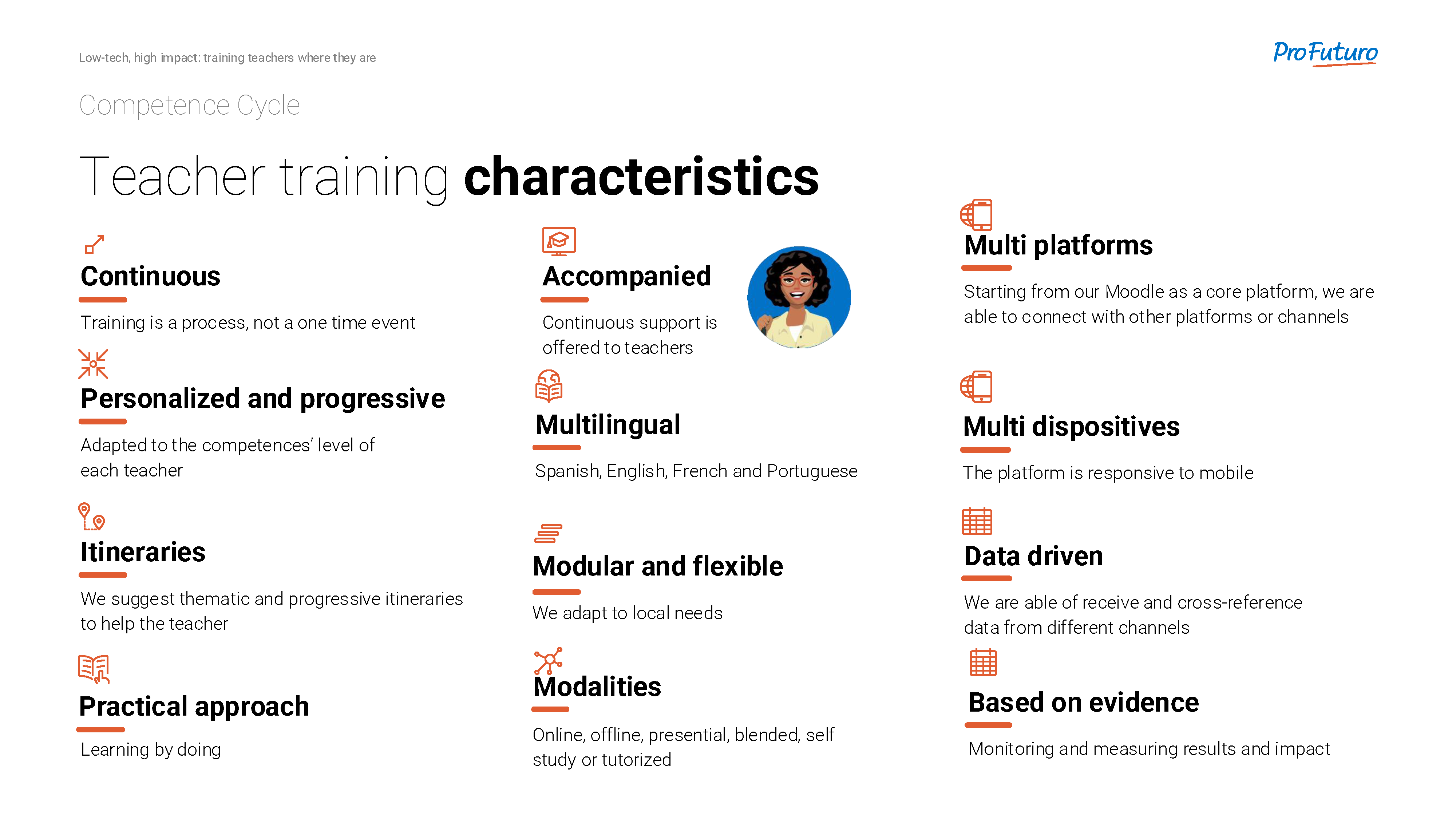
  2. Training that is continuous, flexible, progressive, and practical, to reduce skills gaps and empower teachers. 
  3. Practice, with access to a broad catalogue of online and offline educational resources for classroom use. 
     
ProFuturo
Key characteristics of ProFuturo’s approach to teacher training.


Through implementing their solutions with 1.8 million teachers in 30 countries, ProFuturo has identified a number of key lessons. Educational change is a cultural and systemic process centered on teachers, making their training essential for improving quality. This focus on teachers ensures high-quality training delivery, while flexibility and preparedness allow effective responses to diverse situations and challenges. 

Recognizing limits and managing expectations, alongside sustaining continuous innovation and strong collaboration, allow organizations like ProFuturo to address the complexity of training teachers across extremely diverse contexts. 
 

“Strategic partnerships enable the sharing of resources and expertise, ensuring that the program is well-supported and aligned with global educational initiatives” - Mila Tonarelli, ProFuturo


Key Takeaways and Next Steps

After the webinar, participants were surveyed to gather perspectives on teacher training strategies and needs in their own contexts. The following common themes emerged: 

  1. Teachers of the future will need to be digitally fluent, adaptable lifelong learners who foster student well-being, communicate effectively, and navigate evolving pedagogical and technological landscapes.
  2. Key teacher training challenges include limited funding and infrastructure; inequitable access to training opportunities, particularly in rural areas; and an overfocus on pre-service training with a lack of ongoing, relevant, and inclusive professional development.
  3. Successful teacher training strategies encompass peer and community-based learning; flexible digital and hybrid formats; hands-on coaching; and practical, learner-centered approaches that promote collaboration and continuous growth. Necessary conditions for effective training partnerships include a shared vision and trust, mutual commitment with aligned goals, and empowered and actively engaged local teams.

Based on the discussion, it’s clear that this is a common priority. There is a need for low-tech and mobile teacher training and ongoing professional development across all education systems. This initial webinar and blog are the start of a series of professional conversations in which the Teacher Task Force members dive deeper into the challenges, solutions, and best practices. 
 

Additional Resources

Future Teacher Kit

ProFuturo


Hero photo credit: BMZ, GIZ, UNESCO, UNICEF.

News
  • 28.02.2024

UN Secretary-General’s High-Level Panel on the Teaching Profession puts forward recommendations to allow teachers to become drivers of change in education

This is the UN press release released on 26 February 2024 on the occasion of the launch of the UN Secretary-General’s High-Level Panel on the Teaching Profession during the Teacher Task Force 14th Policy Dialogue Forum.


Recommendations from the UN Secretary-General’s High-Level Panel on the Teaching Profession, aimed at transforming the future of the teaching profession, were launched today at the 14th Policy Dialogue Forum of the International Task Force on Teachers for Education 2030 (TTF).

Teachers are central to nurturing every country’s greatest resource: the minds of its people. Yet today, we face a dramatic shortage of teachers worldwide, and millions of teachers who lack the support, skills and continuing training they need to meet the demands of rapidly changing education systems,: said UN Secretary-General António Guterres.

Building on the landmark UN Summit on Transforming Education in 2022 and supported jointly by the ILO and UNESCO, the High-Level Panel’s recommendations are based on six core imperatives, covering dignity, humanity, diversity, equity and inclusion, quality, innovation and leadership and sustainability.

The High-Level Panel’s wide-ranging recommendations are premised on the need to value and respect the teaching profession – this requires decent working conditions, competitive wages, space for teacher voice in decision-making and opportunities for development and innovation,” said Paula Mae Weekes, Co-Chair of the Panel and former President of Trinidad and Tobago.

The recommendations are intended to create an enabling environment that allows teachers to become drivers of change in education, who can help learners critically navigate knowledge and gain the skills and competencies needed in today’s world. Teachers should not be simple conveyers of information but active and collaborative partners for learners, the Panel noted. Adequate financing of education systems and effective integration of technology for learning were cross-cutting themes in the development of the recommendations.

Technology holds tremendous potential for both teaching and learning so long as it is put to use in ways that are supportive of teacher inputs over its pedagogical use, the integrity of the profession and is equitably integrated,” said Kersti Kaljulaid, Co-Chair of the Panel and former President of Estonia.

With new data from UNESCO showing that some 44 million primary and secondary teachers will be needed by 2030 to reach Sustainable Development Goal targets on education, issues of teacher working conditions, wages, autonomy, initial training and continuous professional development all featured heavily on discussions of teacher recruitment and retention. Panellists condemned the use of precarious teaching contracts and austerity policies that undermine teacher working conditions and the quality of education. Further recommendations relate to ensuring gender equity, promoting sustainable development and supporting teacher leadership. A push for greater diversity and inclusion in the teaching workforce, as well as greater social dialogue among partners on both the national and international levels were highlighted.

The full report of the High-Level Panel can be found here.

About:

The High-Level Panel on the Teaching Profession was established by the UN Secretary-General in response to challenges facing the teaching profession and education systems worldwide, and as a key follow-up to the UN Transforming Education Summit of 2022.  The panel was supported jointly by the International Labor Organization (ILO) and the United Nations Educational, Scientific and Cultural Organization (UNESCO). The 18 panel members include government ministers of education and labour, representatives of teacher trade unions, academics, civil society leaders and teachers and students representing every continent.

More information is available here: www.ilo.org/global/industries-and-sectors/education/teaching-profession

Media Contacts (interviews available upon request)

ILO: newsroom@ilo.org

UNESCO: Clare O’Hagan, c.o-hagan@unesco.org , +33145681729

News
  • 23.06.2023

High-Level Panel on the Teaching Profession: Towards a new global vision to improve the conditions of teachers around the world

In its 2022 advocacy brief, the Teacher Task Force brought to the forefront the work and recommendations coming out of the Transforming Education Summit, especially concerning the thematic action track on teachers. An essential observation came out of the work and reflections of all partners and Member States - there is a clear need for global initiatives on national teacher policies.

On 19 June 2023 the United Nations Secretary-General announced the establishment of a High-Level Panel on the Teaching Profession which will build on the outcomes of the Transforming Education Summit to ensure that every learner has access to a professionally trained, qualified, and well-supported teacher who can thrive within a transformed education system. 

"We are facing an extraordinary global teacher shortage. 16.5 million primary and secondary education teachers need to be recruited in sub-Saharan Africa alone. We need to accelerate our efforts to improve the status of teachers and their working conditions to make the profession more attractive. The establishment of the High-Level Panel on the Teaching Profession marks a crucial milestone in our efforts towards this goal. The recommendations of this diverse panel of experts and stakeholders will support meaningful change and ensure every learner has a well-supported and qualified teacher," says Stefania Giannini, UNESCO Assistant Director-General for Education.

Supported by a joint UNESCO – International Labour Organization (ILO) Secretariat, the Panel will draw together ministries, teachers, students, unions, civil society, the private sector, and academia. The Panel’s report will serve as a contribution to broader efforts to achieve Sustainable Development Goal 4, as an input to ongoing preparations for the 2024 Summit of the Future and help advance follow-up on the Transforming Education Summit.

As it did during the Transforming Education Summit, the Teacher Task Force will utilize its extensive and diverse network of stakeholders to harness knowledge, expertise, and resources in support of the High-level Panel. The first UNESCO-Teacher Task Force Global Report on Teachers, scheduled for release later this year, will both draw from the Panel's work and contribute valuable insights to it.

The Teacher Task Force will be represented at the High-level Panel by one of its co-Chairs, Ms Matsie Angelina Motshekga, Minister of Basic Education of South Africa, and will benefit from the contributions of TTF Steering Committee members; namely, ILO, and Education International.

The Teacher Task Force and its network are fully dedicated to providing support to the Panel and the recommendations that will be issued for the overall advancement of the teaching profession.

  • More on the High-Level Panel on the Teaching Profession 
  • Read the Teacher Task Force Advocacy brief which summarizes the main issues and recommendations which were developed as part of the third thematic Action Track on “Teachers, teaching and the teaching profession” of the Transforming Education Summit and proposed concrete strategies and recommendations
  • Read the discussion paper on teachers identifying the ambitions, challenges, opportunities and possible solutions for the teaching profession prepared for the 2022 UN Transforming Education Summit


Photo credit: UN Photo/Mark Garten

Event
  • 22.10.2024

Presentation of the Global Report on Teachers at the Fourth International Educational Conference in Kuwait

The Teacher Task Force will present its Global Report on Teachers, titled Addressing teacher shortages and transforming the profession, at the Fourth International Educational Conference of the Gulf Arab States Educational Research Center (GASERC), taking place on 5-6 November 2024 in Kuwait.

This event will bring together educational leaders, policymakers, and experts to discuss the future of education in Gulf countries, focusing on critical issues like teacher shortages and education reform. The conference will cover a range of themes, including supporting teachers to lead education transformation, the role of digital technologies in education, and improving education financing. The Teacher Task Force will highlight key findings from the Global Report, emphasizing the urgent need to address global teacher shortages and transform the profession.

The event will be conducted in both Arabic and English, with simultaneous interpretation available. Participants can also follow the conference online via a livestream on the GASERC YouTube channel, with recorded sessions available afterward.