Event
  • 11.06.2021

Improving the quality of education: The role of social dialogue between governments and teachers

In our collective effort to achieve SDG 4, the voice of the teaching profession is key. In this webinar we will focus on the importance of cooperation between the authorities and teacher unions to provide quality education for children and students.

To secure quality education and professional issues, social dialogue is essential. The benefits of dialogue between authorities and the teaching profession, and how it contributes to quality education, will be highlighted. We will look closer into how dialogue strengthens the development and implementation of education plans and curriculums, as well as the roles and responsibilities of the social partners in the education sector.  

The webinar will draw on the lessons learnt / experience from the Norwegian Teachers Initiative.

Participants:
Dr Yaw Osei Adutwum, Minister of Education in Ghana
Dag-Inge Ulstein, Minister of Development Cooperation Norway
Mrs Philippa Larsen, President of Ghana Association of Teachers
Mr Borhene Chakroun (UNESCO/NTI)
Steffen Handal, President of Union of Education Norway

Moderator Bård Vegar Solhjell, Director of Norad

Please register here.
Event
  • 07.06.2021

Teachers as agents for change for inclusive education - Webinar

Background Information

The GEM Report, NEPCs, EASNIE and the International Task Force on Teachers for Education 2030 will convene an interactive webinar on the findings and recommendations from the 2021 Central and Eastern Europe, Caucasus and Central Asia Report on inclusion and education.

The Report provides comparative analysis on inclusion and education for all learners regardless of background or ability across 30 education systems. Teachers from across the region are key agents for change when it comes to inclusion in education. In total, 17 education systems across the region have legislation or policies that support the development of learning communities to widen teachers’ professional development opportunities and share experiences and effective practices to strengthen equity and inclusion.


Objectives of the event

The event will spotlight the activities of teachers as change makers across the region working to ensure that every child has the right to go to school and learn regardless of who they are and where they live.

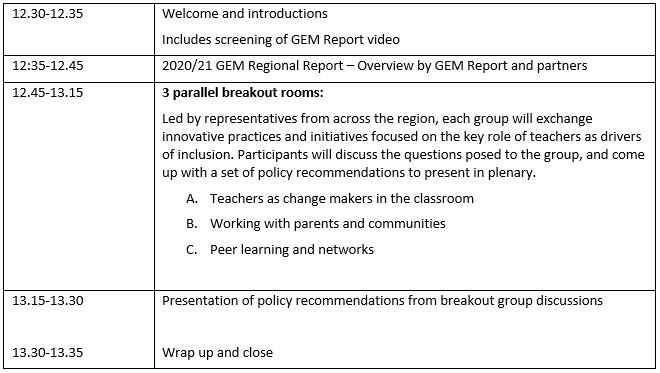
The format will include a presentation of the new 2021 regional report as well as smaller group discussions, with a particular focus on the role of teachers as change makers within the classroom, school community and the teaching profession.

  1. Teachers as change makers – will illuminate initiatives to foster an inclusive ethos in schools, including practices to elevate student voices for inclusion with a focus on engaging the most marginalized learners.
  2. Working with parents and school communities - will discuss promising practices to establish partnerships between parents, communities and teaching staff to strengthen inclusion both inside and outside the classroom.
  3. Strengthening inclusive practices within the teaching profession – will share insights into these regional learning communities and connect likeminded professionals to share experiences and effective practices to foster inclusion in education.

Please register here.

Agenda

Agenda

Event
  • 07.06.2021

Teachers as agents for change for inclusive education - Webinar

Background Information

The GEM Report, NEPCs, EASNIE and the International Task Force on Teachers for Education 2030 will convene an interactive webinar on the findings and recommendations from the 2021 Central and Eastern Europe, Caucasus and Central Asia Report on inclusion and education.

The Report provides comparative analysis on inclusion and education for all learners regardless of background or ability across 30 education systems. Teachers from across the region are key agents for change when it comes to inclusion in education. In total, 17 education systems across the region have legislation or policies that support the development of learning communities to widen teachers’ professional development opportunities and share experiences and effective practices to strengthen equity and inclusion.


Objectives of the event

The event will spotlight the activities of teachers as change makers across the region working to ensure that every child has the right to go to school and learn regardless of who they are and where they live.

The format will include a presentation of the new 2021 regional report as well as smaller group discussions, with a particular focus on the role of teachers as change makers within the classroom, school community and the teaching profession.

  1. Teachers as change makers – will illuminate initiatives to foster an inclusive ethos in schools, including practices to elevate student voices for inclusion with a focus on engaging the most marginalized learners.
  2. Working with parents and school communities - will discuss promising practices to establish partnerships between parents, communities and teaching staff to strengthen inclusion both inside and outside the classroom.
  3. Strengthening inclusive practices within the teaching profession – will share insights into these regional learning communities and connect likeminded professionals to share experiences and effective practices to foster inclusion in education.

Please register here.

Agenda

Agenda

Blog
  • 25.05.2020

Near or Far as a TEAM: Together Everyone Achieves More

TEAM is central to my philsophy of teaching and learning. Through 18 years of teaching, I have found TEAM supports learners develop a sense of belonging to their learning community, which is essential for their social, emotional, and cognitive flourishing.

During the COVID-19 crisis maintaining TEAM has been an essential aspect of ensuring ongoing education provision.

TEAM at a Distance

Professional Community Connection

With the onset of the COVID-19 crisis school staff were quick to mobilize. It was an ‘all hands on deck’ approach to support the transition to distance learning. In the first instance, all children were issued Chrome books to take home for the duration of the crisis, and staff development sessions enabled teachers to make the transition to online learning using Google Classroom. These sessions began in a face-to-face environment and transitioned to online as the ‘Stay at Home’ orders were issued. The strength of our professional community emerged in these early days, as colleagues supported one another making the transition, learning new instructional tools, and discussing how to support learning at a distance. From the Suite of Google Apps, teachers adopted Google Classroom, Google Meet, and JamBoard. Within Google Classroom, Google forms are used for quizzes; videos and interactive online activities from Educational support sites like EdPuzzle, Legends of Learning, ABCYa, and YouTube support learners engage with content.

Weekly Google Meet staff meetings have been an asset – promoting teacher and staff well-being, through opportunity to de-stress, share worries and successes, get Education updates, and to reboot for the week to come. These have highlighted for me, the importance of maintaining a strong professional community connection in order to ensure continued teaching and learning.

Professional development (PD) has been available in-school and at district level. Our school Director of Technology and Media, and the district level Technology Integration Specialist have provided 1:1 and small group instructional support on various technologies via ZOOM and Google MEET. I have benefitted directly, learning how to use Flipgrid, Screencastify, and Google Slides to integrate stop animation into my programming.

A strength of this PD support has been the openness to individual interests. My interest in establishing a District-wide Professional Learning Community Forum has been readily embraced by the District Tech., who acted immediately, setting it up for elementary teachers. Teachers can access the space to support one another through professional discussion and shared practice-related experiences.


Building Community through Parental Connection

I have used technology to develop TEAM-like connections with parents. A key part of TEAM has been working with parents to help them become comfortable and connected with the new learning environment. ‘Google Class tours’ using Google Meet, regular emails, and timely Google Meet drop-in sessions allow parents to connect with me to provide feedback, ask questions, and to troubleshoot dilemmas. Parents have become ‘class members’ to Google Classroom and ClassDojo, where they can track their children’s activity and see a portfolio of  their children’s work. Strong parent-teacher-child partnerships have been a tremendous asset to the success of online learning.


Nothing Like Routine: Keeping Students Connected

Developing an online TEAM with the children has been essential to ensure their ongoing learning. Routine has been an important element. Children use Google Classroom to access their daily schedule, and lesson activities. We meet every morning for our Morning Meeting, which involves many of the same routines that defined our first 30 minutes of ‘normal’ in-class activity.  Adding to this, ClassDojo has been an invaluable resource to maintain a focus on working together. I can take attendance, share videos that support Social Emotional Learning topics; use positive incentives; and create student portfolios. All of these features mirror routines the children had in the classroom, which has supported maintaining their class-connectedness.

As a school, we have developed a Daily News programme, written and hosted by our P.E. teacher. This program continues the routines that defined the beginning of our in-school, school day including birthday announcements, certificate awards, prayers and Pledge lead by 6th Graders via video recording.  The Daily News hosts photos that children send in, showcasing activities they have participated in and work that they have completed. It is a valuable sharing time that consolidates our connectedness as a community.


A Different Way to Teach

This crisis has certainly challenged my creativity, innovation, and flexible approaches to practice. It has underscored the importance of continued professional learning. Adopting a distance learning approach with children has demanded complex thinking – trying to ensure the social, emotional aspects are included; trying to be sure the children are connected as learners; and trying to introduce new concepts with tools that don’t always support practices essential for children’s learning, takes resilience, constant reflection, and a willingness to ‘have another go’!


Wendee White

5Th Grade Elementary School Teacher, Syracuse, NY, USA

************************

This piece is part of the Teacher Task Force’s #TeachersVoices campaign, created to bring forward the experiences of teachers working every day to ensure their students continue to benefit from a quality education despite the COVID-19 pandemic. To participate, go to our dedicated webpage.

Blog
  • 15.05.2020

Preschool students thrive on distance learning – but yearn to get back to school

Greetings to you all from Turkey. My name is Nurten Akkuş. I am a Global Teacher Prize Top 10 Finalist. I am a preschool teacher –my students are between the ages of 3 and 6. I work in a socio-economically disadvantaged area, where I seek to change and improve people’s lives with education. I attach great importance to paying attention to the individual characteristics of my students. We have made our class and school suitable for the development of my students. We enjoy education by having fun and discovering together. Before the coronavirus entered our lives, we had a great school environment. However, suddenly we had to move this educational environment that we created to digital media.

The virus first reached our country in early March. Everyone was in panic as the world woke up to the epidemic and thousands of people died. Our health ministry and state administrators gave out information about precautions to take. The schools were on vacation. People in our country were called on to “stay home” to try to prevent the spread of the epidemic.

Around the world, we are having a very difficult time. Schools are closed in many countries. We cannot teach face to face. But we are teachers. Our students and their families are always very important to us. It was very difficult to explain this situation to all our students, because we loved learning and school with our students. Families and children were very worried about the virus. I wanted to reduce anxiety before we began teaching online. I had to increase their motivation.

First of all, I talked to the families. I told them that although we need to pay attention to the news, excessive anxiety will be negative in children. I did family education online. We constantly communicate with the groups we have created with them.

Then I spoke to my students online. It was a different experience for them. I told them how we should pay attention to cleaning, and what the virus is, in a simple way suitable for age groups. I asked the children to make part of their home an activity centre. They made their home environment fun.

A great system was made by our Ministry of National Education. Distance education was supported with TV channels. Online training content, game activities and books were prepared. We have set up an online classroom with this system. We share our daily activities there. We also share the daily education flow with the families and enable them to participate in these activities. We carry out many activities with our students such as art, science, plant breeding, vital skills training, free activities, drama, design, mathematics and language education. Through this process, psychological support has been provided for students and families in our country.  

All teachers are constantly communicating with their students in Turkey. Distance education methods and educational content are further developed by our Ministry of National Education. Despite the fact that my students are young, they are obliged to learn via distance learning methods. Families and teachers take an active role in the distance education process. I have given lectures in Turkey and many different countries. But I am giving online conferences right now. Teachers always believe that face-to-face education is very important. This is absolutely true, however, teachers now think that given the critical situation in the world, opportunities for distance education should be well known.

The Varkey Foundation, which works to build the capacity of teachers, offers a great chance for teachers to meet online to discuss methods in different countries of the world.

In a very short time, we have become used to living with digital life and learning. Of course, we miss being with our students and our school. They also miss us. However, my students’ health is very important. And they should not miss out on their education. I hope this epidemic ends as soon as possible in both my country and the rest of the world, so that all people in the world are healthy and that all children can go back to school.

Nurten Akkuş

Nurten Akkuş was one of the finalists of the Varkey Foundation's Global Teacher Prize.

**********************************************************

This piece is part of the Teacher Task Force’s #TeachersVoices campaign, created to bring forward the experiences of teachers working every day to ensure their students continue to benefit from a quality education despite the COVID-19 pandemic. To participate, go to our dedicated webpage.

Blog
  • 07.05.2020

Online teaching during the COVID-19 crisis

I have been a physics teacher in secondary school (grades 9-12) for twenty-five years, and during that time have always been sure to share and publish things I do with students to provide examples and ideas that may benefit my teacher colleagues and their students. The easiest way to share is to put everything online, so that both students and other teachers may access resources at any time. Whether having a live classroom of students or teaching an online course, which I have done with Northwestern University, having Internet platforms on which to put teaching and learning resources has always been part of what I do as a teacher, and I recommend all teachers begin to take this approach if the technology is available. While never being in a situation like we have now because the COVID-19 crisis, where teachers must move materials online for students, the transition for me during this crisis is minimal since I am already setup for online teaching and learning.

There are numerous online platforms on which to put classroom resources, as well as video conferencing platforms that can be used to hold live class sessions with students or meetings with colleagues. With technology, we can make distance learning as close to a live class session as possible. For my students, the everyday class materials are on a Google web page that is linked through my school’s website. I have separate folders for each class, so students can access the appropriate material. I also have maintained a separate class blog for years. This is a normal tool students are used to accessing since many of the posts come from student recommendations they want to share with everyone. On the blog, I have different pages dedicated to different activities and resources students find helpful and interesting. For example, before the era of Khan Academy and online ‘how to’ lessons, I had already been making screencast videos of most of the topics I cover in my physics classes and formed an online library of over 100 videos for students.  In the past, the reason for doing these videos was primarily for two reasons: for students to have a resource outside of school when working on homework and needing to review the material at their own pace; and when a student misses a day, I can provide the appropriate video for them to watch and see what we did for that topic. There is also an increase in views before exams, when students are reviewing the relevant topics. Each video is stored on YouTube, and the videos are public for any student or teacher to use.

With the current situation, I post video links for students to watch either before (i.e. a ‘flipped’ classroom) or after an online class session. My preferred videoconferencing tool is Zoom. Teachers can open a free Zoom account that allows for 40-minute sessions. Students do not need Zoom accounts, but only a link that the teacher can post on a web page or email to students. I record each class session, put the video on YouTube, and then share with students on the class blog. If a student is absent or needs to review the class session, they can watch at their convenience. On a class website, teachers can post homework sets, labs, worksheets, assignments, help resources, articles and any other videos or websites. Students email me questions, or can organize virtual study groups through chatrooms, shared Google Documents, Facetime, Zoom, or Skype; or they can call each other on a phone. I setup Google Sheets for each group of students to share questions about materials, but also share new things they are trying during down-time while being in isolation: keep a focus on student mental and emotional health, because they will get lonely and will miss being in school!  Do NOT overwhelm them with too much work, because this is new for them, too.

I am fortunate my school has wonderful supports in place to help all teachers and students with this transition to e-Learning. We have staff dedicated to providing numerous online options and training staff on how to use the technology. We have Zoom department meetings to share what we are doing with our classes, and have email and texting groups for each discipline so teachers can support each other. The best advice I offer is to have good communication with both colleagues and students: listen to everyone and learn, and get feedback from students. Students are the ones who matter – they are getting different presentations from different teachers, and will tell you what works and does not work if you ask them! We need to be sure we are listening to the students so we can best serve them.


Mark Vondracek

Mark Vondracek was one of the finalists of the Varkey Foundation's Global Teacher Prize.

**********************************************************

This piece is part of the Teacher Task Force’s #TeachersVoices campaign, created to bring forward the experiences of teachers working every day to ensure their students continue to benefit from a quality education despite the COVID-19 pandemic. To participate, go to our dedicated webpage.


Blog
  • 30.04.2020

‘Zooming’ in on learning during Covid-19 - #TeachersVoices

My name is Anne-Fleur Lurvink and I am a teacher at Lyceum Kralingen, a secondary school in Rotterdam, the Netherlands. I teach English as a foreign language to students between the ages of 15 to 18. I am also mentor to a group of 21 students, head of department and coordinator for the UNESCO Associated School Network. In addition to teaching, I also work in the field of international development where I act as consultant for youth empowerment and education. 

When I entered the field of education I could have never imagined a crisis like the current COVID-19 crisis to knock on our door. Being part of an enthusiastic and energetic team, committed to ensure learning in these challenging times, has made all the difference.


Necessity is the mother of invention

When the news arrived that schools would close, we really collaborated as a team. Teachers came together at school for a brief brainstorm session and started transforming the curriculum to an online one in just one day. Of course we are still learning and figuring it out as we go along, but what makes it manageable is the fact that we are in it together.

Teacher development has accelerated and peer learning has been central to it. When one of us faces some challenges, others step in, organise a team zoom and we learn from each other. We are also drawing on our creativity and out-of-the-box thinking. For example, we have replaced test with small research projects. There is also a range of free online applications for e-learning available. One very useful website is https://www.todaysteachingtools.com/ which offers different flowcharts to figure out which ICT tool is fit for which purpose. It also offers a free online course for language e-learning.

In addition, I try to include my students in the process. They often have a much broader knowledge of ICT and they have given me great suggestions and feedback (such as how to switch off the annotation mode in Zoom when I do not want creative expressions of my students to appear on my PowerPoint).

We also try and keep up good spirits by approaching things with a sense of humour, accept it when things do not go as planned and have a good laugh from time to time. It is also important to give our students confidence that this situation will end that they will be fine.


The challenges

Despite the many creative solutions and increased collaboration amongst teachers, there are many challenges to be faced. There is the obvious work-home balance, which is hard to maintain with non-stop online availability, and matters of digital (il)literacy.

Online learning is based on the assumption that students have the possibility to follow online learning at home. Unfortunately this is not the case for all students. Less advantaged children have a greater chance of falling behind and the equity gap is increasing during this crisis.

We also worry about the social and emotional well-being of our students. It has become more apparent than ever that schools are more than just places where knowledge is transferred. It is where children socialise and where they grow. Schools are safe places for those who have unstable homes. How to ensure this at a distance? The role of the mentor has become more important because we are responsible for connecting with students and their parents.

In addition to online lessons, we also organise one lesson a week just to chat and to keep up to date on how students are coping. Together with the care-team at school we try to monitor every student and their well-being, but this is extremely difficult. Some students go off the radar and schools can’t get in touch with them or their parents.


Teacher empowerment

Here we have been given the confidence to come up with solutions and ideas and we are part of the policy dialogue at our schools. I believe this to be essential in order to maintain learning at a distance.

As a teacher you know your context, you know your students and you know what they need. In terms of learning and leaving no one behind, facilitating teachers to face this challenge will determine the out-come of this crisis. I am happy to be part of several networks of teachers and educators from across the globe, exchanging experiences and sharing knowledge. I would also recommend this to other teachers.

Join these networks and webinars and let’s bundle our strengths!


Some networks and platforms

**********************************************************

This piece is part of the Teacher Task Force’s #TeachersVoices campaign, created to bring forward the experiences of teachers working every day to ensure their students continue to benefit from a quality education despite the COVID-19 pandemic. To participate, go to our dedicated webpage.