
What are young people telling us about the education they need, and what does this mean for teachers and the policies that support them?
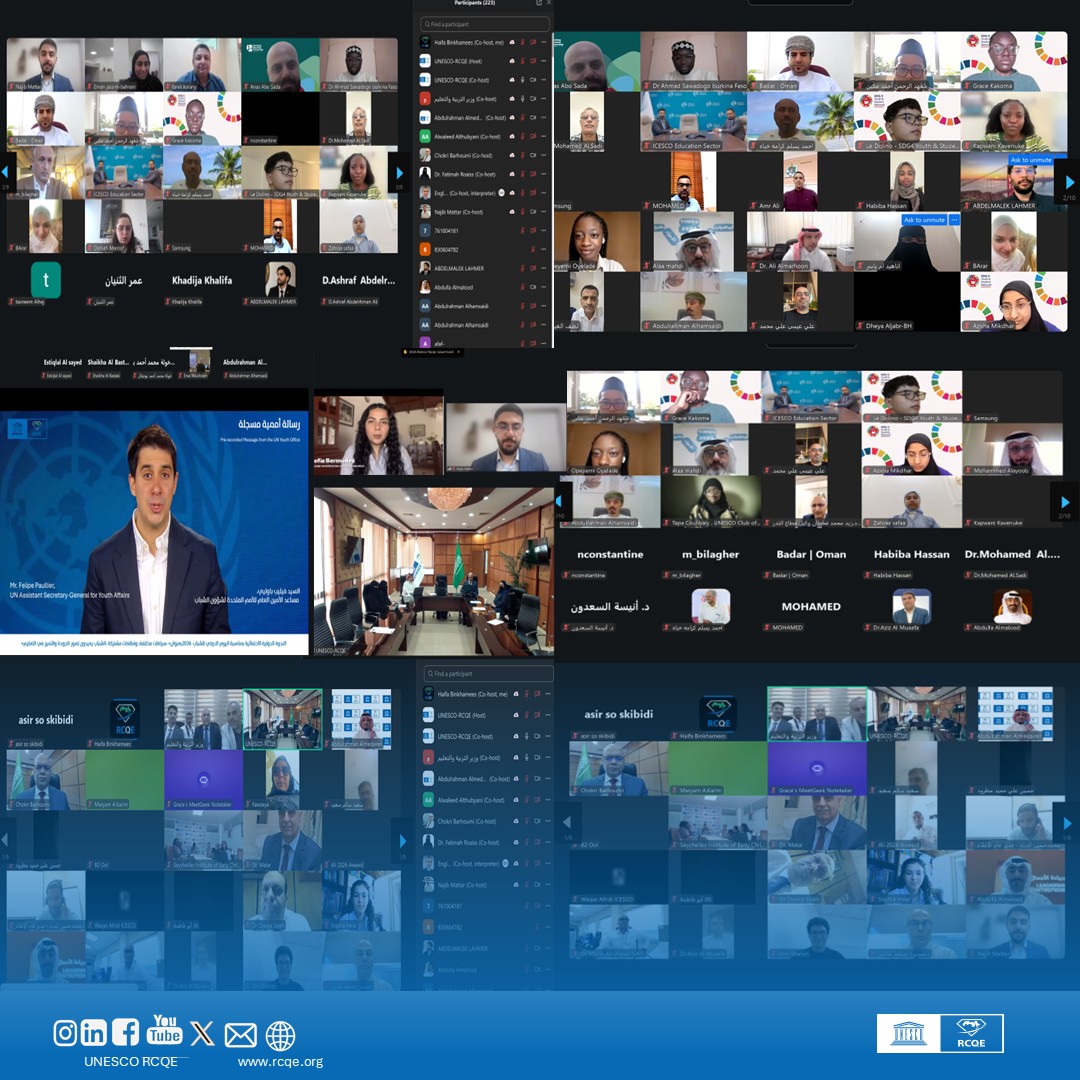
This question was at the heart of the international seminar organized by the UNESCO Regional Center for Quality and Excellence in Education (RCQE), in cooperation with the Ministry of Education of the Republic of Yemen, on 12 August 2026, on the occasion of International Youth Day, under the title: “Different Contexts, Shared Aspirations: Young People Reimagine Quality and Excellence in Education.”
The seminar brought together young people from different regions of the world and from diverse contexts, alongside policymakers, experts, researchers and international partners, to examine the quality of education from the perspective of those who experience learning firsthand. Despite the diversity of participants’ circumstances, common aspirations emerged for equitable, inclusive and meaningful education; teachers who are able to keep pace with transformation; curricula connected to future skills and employment; responsible use of technology and artificial intelligence; and meaningful youth participation in educational decision-making.
What are youth voices telling teachers and policymakers?
Young people do not experience education policies as abstract documents; they experience their impact in the classroom, in the quality of their relationship with teachers, through curricula and assessment, and in the opportunities education provides for the transition to work and participation in society.
The interactive survey accompanying the seminar clearly reflected this perspective. Connecting education with training and the labour market emerged as one of the leading elements of quality education identified by participants, alongside teacher competence, digital learning environments and curriculum renewal. Technological and AI-related skills, critical thinking and problem-solving were also highlighted among the most important skills required for the future.
At the same time, young people did not view technology as a substitute for teachers. Their vision for the future of education was associated with an evolving role for teachers as guides and facilitators of learning, while preserving the human dimension of education and establishing clear safeguards for the responsible use of artificial intelligence.
This is where the importance of connecting learner voice with teacher voice becomes particularly evident. Quality education requires professionally empowered teachers who are able to respond to diversity, use technology effectively and responsibly, and support learners in developing the skills they need in a rapidly changing world.
Quality education beyond 2030: From measuring inputs to measuring impact
The seminar addressed a number of future priorities for quality and excellence in education beyond 2030, in the context of artificial intelligence and rapidly evolving skills and labour markets. Discussions highlighted the need to move beyond a primary focus on inputs and processes towards measuring impact, sustainability, global citizenship, adaptability and the capacity to relearn, while building education systems that are more flexible and human-centred.
Contributors also emphasized the need for flexible and anticipatory quality models that do not merely respond to change after it occurs, but instead anticipate future transformations and help education systems prepare for them, while respecting the specific characteristics of national and local contexts.
Artificial intelligence is redefining quality standards
In the age of generative artificial intelligence, the quality of education is no longer determined only by what a learner knows or by the qualification they obtain, but also by their capacity to learn, relearn and continuously adapt as jobs and technologies evolve.
From this perspective, the seminar discussed the importance of gradually moving beyond an exclusive focus on academic qualifications towards greater recognition of verifiable and transferable competencies and skills, including through models such as micro-credentials and stackable credentials. It also considered the development of more personalized forms of learning in which the educational experience responds more closely to each learner’s needs, pace and learning style.
One of the emerging standards of quality education, therefore, is the learner’s ability to review what they have learned, let go of what is no longer relevant, and rebuild their skills as knowledge and labour-market requirements change.
Human-centred quality and well-being
The discussions emphasized that digital transformation should not reduce the quality of education to a purely technical issue. Future excellence in education requires the integration of digital well-being, mental health, well-being and the human dimension into quality standards themselves, rather than treating them as later additions.
The growing use of data and artificial intelligence also requires clear principles for ethical and responsible use, digital equity, safeguards against bias in intelligent education algorithms, and the protection of every learner’s right to a safe and equitable learning environment.
Beyond 2030: Ethics, skills and sustainability
The seminar also explored several challenges likely to shape the future of education quality beyond 2030, particularly the ethical gap in intelligent education, the skills crisis and the sustainability of financing.
Addressing the ethical gap requires safeguarding digital equity and tackling bias in AI-enabled education applications and algorithms. The skills crisis calls for frameworks more closely linked to lifelong learning, particularly as knowledge and skills become outdated at an accelerating pace. Financial sustainability, meanwhile, requires more flexible models capable of protecting the quality and continuity of education in the face of economic and environmental shocks.
Contributors therefore called for the development of flexible national quality frameworks that are periodically renewed in response to changing future requirements, accommodate new technologies, labour-market transformation and global standards, and at the same time preserve national ownership and local and institutional flexibility.
In this sense, excellence beyond 2030 will not be a fixed state, but a continuous process of development driven by innovation and grounded in human values. Future quality will not mean merely applying today’s standards successfully; it will also mean developing new standards capable of responding to the world of tomorrow.
Youth voice and teacher voice: A partnership for policymaking
Meaningful youth participation cannot be fully effective in isolation from teacher voice. Teachers bring direct professional experience of curricula, teaching, assessment and learning environments, while young people contribute knowledge drawn from their own lived experience of learning.
When these two voices come together in structured dialogue with decision-makers, education policies are better positioned to respond to the real needs of learners and teachers alike.
This approach also aligns with international efforts to strengthen the status of teachers and empower them professionally, supporting progress towards SDG target 4.c and strengthening teachers’ capacity to lead educational transformation and respond to future needs.
This discussion is also becoming increasingly important in the context of growing international attention to continuing professional development and lifelong learning for teachers. Education systems’ ability to respond to artificial intelligence and shifting skills demands depends to a significant extent on enabling teachers themselves to continue learning and developing their professional practices.
Youth participation is not separate from teacher policy
When young people contribute to conversations about education, they offer knowledge that can enrich teacher policy itself: What makes learning meaningful? Where do inequities emerge? What skills do learners need? And how are expectations of teachers changing in the age of artificial intelligence?
At the same time, young people need the expertise of teachers and teacher education institutions to translate ideas into solutions that can work in schools and classrooms. Dialogue between young people and teachers can therefore become part of the education policy development cycle: identifying needs, designing responses, piloting them, evaluating their impact and improving them.
Young teachers can participate as members and leaders of initiatives, while experienced teachers and experts can contribute as mentors. Ministries, teacher education institutions and professional organizations can, in turn, help translate ideas into workable practices and policies.
In practical terms, education institutions can establish regular and structured channels that bring together young people, teachers and policymakers to discuss curricula, future skills, the use of artificial intelligence and the evaluation of education reforms. This can help transform participation from a one-off event into a sustainable institutional practice.
From the seminar to a youth-led global network
To turn this dialogue into sustained participation, RCQE launched the Global Youth Network for Quality and Excellence in Education (GYNQE) during the seminar.
The Network is a global platform that seeks to bring together students, young researchers, teachers and professionals, youth leaders, innovators and entrepreneurs from diverse contexts, and enable them to contribute to knowledge production, foresight on the future of quality and excellence, the design of initiatives and solutions, and the development of education policies and decisions.
The Network will operate through pathways that include a Youth Voices Observatory, innovation and foresight labs, capacity-building programmes, working groups, international dialogues, research and policy programmes, and a youth ambassadors programme, with particular attention to under-represented young people, persons with disabilities, and young people affected by crises and conflict.
The Network’s success will not be measured by the number of members alone. More importantly, it will be measured by its capacity to transform youth voices into usable knowledge, ideas into initiatives, and recommendations into policies and programmes, while building partnerships that connect young people with teachers, institutions and decision-makers.
Building the future together
The seminar demonstrated that different contexts do not erase shared aspirations. Young people want quality and equitable education, qualified and empowered teachers, skills that help them shape their futures, and meaningful opportunities to contribute to educational development.
As the international community looks towards the future of education beyond 2030, we may need to move from asking, “What kind of education should we provide for young people?” to a more collaborative question: “How can young people and teachers build the future of education together?”
Through the Global Youth Network for Quality and Excellence in Education, the UNESCO Regional Center for Quality and Excellence in Education seeks to help build this bridge: between youth voice and teacher expertise, between dialogue and policy, and between participation and impact.
In this context, RCQE invites the teaching community, teacher education institutions, ministries, professional organizations and international partners to explore opportunities for collaboration with the Network and to connect youth voices with teacher expertise and education policy dialogues at national, regional and international levels.
To join the Network:
http://gynqe.unesco.rcqe.org/