Blog
  • 28.05.2026

What we learned from a virtual community of practice on teacher pre-service education in Africa

This blog has been co-authored by Maryann J. Dreas-Shaikha and Quentin Wodon from the UNESCO UNESCO’s International Institute for Capacity Building in Africa (IICBA).

Pre-service education for teachers is key to improve teaching and learning in Africa. To share good practices on pre-service education in Africa, UNESCO’s International Institute for Capacity Building in Africa (IICBA) implemented a virtual Community of Practice (CoP) in the second half of 2025. This post outlines a few lessons learned.

A space for peer learning across countries

The aim of the CoP was to promote an exchange of ideas and policies, frameworks, and evidence-proven practices in teacher education. The CoP was open to regional experts, practitioners, and policy actors who were interested in joining a peer exchange platform to deepen their understanding of teacher education in Africa and enhance their capacity to contribute to reform efforts in their own country or organization. While originally envisioned as a platform for government officers and teacher educators, the CoP was expanded to admit school leaders and head teachers, which provided rich context on the experiences of teachers and their professional development needs.

The CoP was organized by IICBA with funding and facilitation from the Global Partnership for Education’s Knowledge and Innovation Exchange (GPE KIX) Africa 19 Hub, a joint project with the International Development Research Centre (IDRC) of Canada. Partners included the European Union’s Regional Teachers Initiative for Africa (EU-RTIA), the Shanghai Funds-in-Trust, the Africa Federation of Teaching Regulatory Authorities (AFTRA), and the African Union’s Education, Science, Technology, and Innovation Department. The CoP ran from July to December 2025.
IICBA
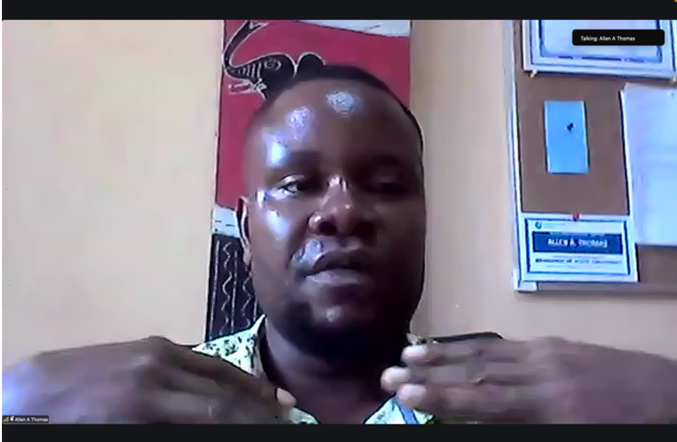
Mr. Allen Thomas, Physics teacher from Liberia and a winner of the 2025 African Union Continental Teacher Awards, shares adaptation strategies for new teachers during an online session in October 2025. Photo credit: UNESCO IICBA.

A variety of key themes explored by the participants

Topics to be covered were selected through a consultative process especially between IICBA and EU-RTIA as the two main sponsors. Focal points from GPE partner countries also influenced the selection of topics through their responses on a prior Knowledge and Innovation Exchange (KIX) Africa 19 Hub country survey facilitated by IICBA which hosts the secretariat of the Hub.  Based on this process, topics chosen for discussion included: (i) Dimensions of effective teacher education and development programs; (ii) Regional guidance on teacher competencies and teaching standards; (iii) Challenges faced by new teachers, teacher educators, and teacher training institutions (TTIs) due to gaps in teacher education curriculum and implementation; (iv) Reforms and innovations in pre-service teacher education; and (v) Digital skills integration in pre-service teacher education.

What the CoP revealed about virtual professional learning

Providing time for open discussions is key

The CoP was designed as an online professional learning course with conceptual presentations by experts, experience sharing by national representatives, discussions, and regular, though voluntary, assignments. The aim was to encourage participant discussions directed by facilitators’ questions using a variety of virtual tools for peer-to-peer sharing about challenges, current reform efforts, national aspirations, and participants’ experiences. Ten virtual synchronous workshops were held on Zoom, each lasting at least two hours (and on occasion up to three hours). Each session featured speakers from IICBA and co-organizers, especially AFTRA and the EU-RTIA. A question-and-answer session between the speakers, facilitators, and participants followed each presentation. Then, a learning activity and plenary allowed participants to delve more deeply into the content shared. The sessions were supplemented by asynchronous discussion boards on Google Classroom and WhatsApp. This overall setting was appreciated by participants, but some suggested that having even more time for open discussions, and therefore a less packed agenda for each session, would be beneficial.

Continued participation varies between groups

The CoP had 163 participants who logged in a total of 639 times across sessions from July to December 2025. Participants were almost evenly split between men and women. A total of 29 participants joined all sessions and completed the voluntary course assignments and other requirements to earn certificates of completion. Participants came from 22 countries and could be characterized as belonging to four groups: (1) Policy makers and ministry leadership; (2) Academics and teacher educators; (3) Staff from non-governmental and regulatory bodies; and (4) School leaders and practitioners. Analysis of participation over time reveals attrition over the six months, with high initial participation tapering off mid-course with a committed group that completed finished the course and submitted assignments. Attrition is common in virtual voluntary spaces targeting senior officers and working professionals, especially when the time commitment and workload build up. Attrition was highest among the first group of participants mentioned above (senior officials).

Regular participants tend to be the most satisfied

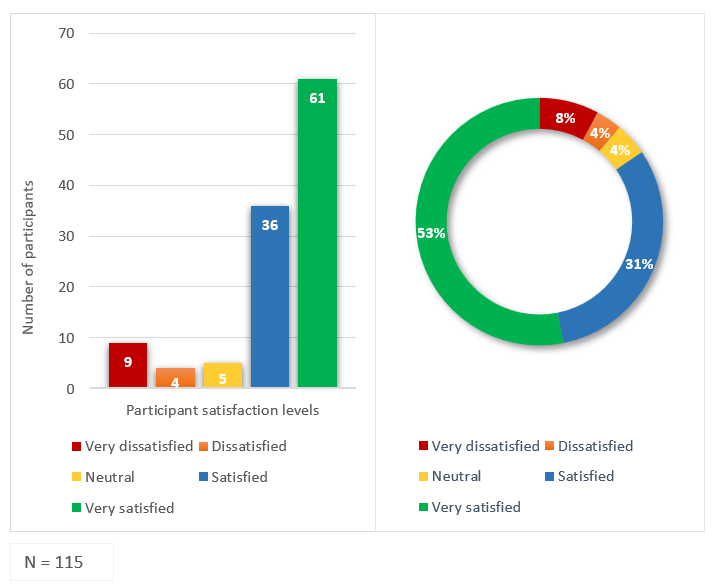
Short satisfaction surveys were implemented after the sessions to which 115 participants responded. As shown in the Figure below, a great majority (84 percent) of participants expressed satisfaction with the course, with 53 percent saying they were very satisfied and 31 percent satisfied with the content and platform. A small percentage (4 percent) were not sure, and 12 percent were not satisfied, mostly due to the fast pace of delivery, a high number of presentations that educed time for discussion, and challenges with technology. As expected, participants who joined most sessions experienced and expressed greater satisfaction with the CoP (conversely, high satisfaction was probably one of the factors leading to the strong presence of some participants).

Participants’ satisfaction with the CoP
participants satisfaction
Source: Authors (UNESCO IICBA).

Assignments for certificates of completion are helpful

Participants were encouraged to complete weekly readings of articles, case studies, and other resources and submit short essays and reflections prior to each session. Participants were also required to submit a long-term assignment to earn a certificate of completion. Assignment options included: (i) Writing a case study paper about the state of pre-service teacher education in their country; (ii) Interviewing teacher educators and/or novice teachers in their country; (iii) Creating and implementing a professional action plan to apply their learning in their departments; and/or (iv) Assessing their country’s teacher education system using a matrix with delineated dimensions of pre-service teacher education and assigned indicators (that matrix was provided by IICBA). Thess assignments proved useful to ensure deeper learning and participation and participants were excited that selected papers they wrote will be published in a special issue of the Journal of Teaching and Learning in Africa of the Africa Federation of Teaching Regulatory Authorities.

Encouraging results and lessons for future CoPs

Continuous professional development for teachers is key to improve learning outcome in Africa. This must start with quality pre-service education. Unfortunately, pre-service education is often ineffective, outdated, and misaligned with teaching realities and the need to upgrade teacher skills in Africa. In addition, evidence on what works tends to be poorly disseminated and underutilized in the design and delivery of programs and curricula. IICBA’s CoP launched in July 2025 aimed to respond to some of those challenges. It had a total of 163 participants from 22 anglophone countries, although only 29 completed all the assignments to receive a certificate of completion. Satisfaction rates among participants were high and participants who completed all assignments submitted work of quality. These findings are encouraging. At the same time, improvements could be made, such as ensuring sufficient time for discussion and helping some participants understand better the technology used in online meetings. Building on this experience, a second module for the CoP will start mid-2026 focusing on in-service professional development.

Resources

Hero photo: Mr. Allen Thomas, Physics teacher from Liberia and a winner of the 2025 African Union Continental Teacher Awards instructs his students in rural Liberia. Photo credit: UNESCO IICBA.

Event
  • 23.03.2026

Africa Teachers Webinar Series: Leveraging eLearning for Teacher Professional Development

Theme of Webinar 2: Leveraging eLearning for Teacher Professional Development: Lifelong Learning Opportunities 

We are happy to welcome you to the next Africa Teachers Webinar series, with the focus on digital skills and AI in higher education and teacher professional development.

There is interpretation available to English, French and Portuguese. Please register through the following link.

Blog
  • 29.09.2025

Youth Voices on the Santiago Consensus: #InvestInTeachers, Invest in Our Future

This blog has been co-authored by Eliane El Haber, Maximiliano Andrade Reyes, Ilan Enverga, Roberto Hernández Juárez, SDG4 Youth & Student Network.

The recently adopted Santiago Consensus, outcome of the World Summit on Teachers in Chile (August 2025), calls the global community to action: to reverse the teacher shortage and to transform teaching into a profession that is fully respected, supported, and empowered.

The Teacher Task Force & UNESCO Global Report on Teachers estimates that the world will need an additional 44 million teachers by 2030 to achieve Sustainable Development Goal 4 (SDG4). The teacher shortage is not just a statistic; it is our classrooms, our peers, our dignity and our futures. As young people, students, and future teachers, we welcome this landmark consensus, but we also see its urgency. That is why we, the SDG4 Youth & Student Network, are proud to have been proud of shaping this consensus through its consultation progress, and are adding our voices to amplify this call.

Financing: Turning Commitments into Reality

No consensus will succeed without financing. The Santiago Consensus emphasizes the need for sustainable, transparent, and equitable financing strategies to support the teaching profession. We could not agree more.

For young people and students, financing is not an abstract concept. It is the difference between overcrowded classrooms and spaces where teachers can provide individual support. It is the difference between teachers leaving the profession due to poor pay, and teachers staying because they feel valued. Financing means salaries that reflect teachers’ worth, safe workplaces, and professional development opportunities.

We join the #FundEducation campaign of the SDG4 High-Level Steering Committee and welcome the Consensus’s strong commitment to uphold international benchmarks for education financing and to explore innovative mechanisms without compromising education as a public good. Public–private partnerships and triangular cooperation can play a catalytic role if designed responsibly, helping expand resources for teacher training and professional development while safeguarding education as a right and a public good. Teachers are not a cost to be minimized; they are the best investment we can make for our societies.

Capacity Building: Supporting Teachers as Lifelong Learners

Teachers, like students, deserve opportunities to grow. The Santiago Consensus calls for teacher education and professional development to be seen as a lifelong journey. This is especially relevant in today’s fast-changing world, where teachers are asked to navigate digital transformation, climate change, and shifting societal expectations.

Capacity building must go beyond technical training. It should recognize teachers in all modalities, including early childhood educators, adult learning facilitators, and TVET instructors, and provide clear pathways for growth and recognition. Importantly, it should also include youth and students, preparing us to step into the teaching profession with confidence, agency, and resilience.

Higher education institutions also have a vital role here. As incubators of teacher training, centers of research, universities and colleges can strengthen bridges between theory and practice, ensuring that teacher preparation evolves with the needs of learners and societies. Furthermore, as artificial intelligence (AI)  and digital tools reshape education, teachers need training to integrate AI responsibly and effectively, ensuring it does not replace human interaction and learning.

Social and Emotional Learning: Teachers at the Heart of Well-being

The global education community often focuses on learning outcomes, but we must not forget the outcomes that matter most to young people and students: feeling safe, supported, and inspired in our learning environments. Teachers are central to this.

The Santiago Consensus highlights the role of teachers in promoting sustainable development, gender equality, and global citizenship. We add another essential dimension: social and emotional learning. Teachers nurture empathy, resilience, and critical thinking. They provide a sense of stability in times of crisis. And they show us, through their care and commitment, how to live together in healthy, inclusive societies. Teachers who are supported in these areas help young people become not only informed citizens but also empathetic leaders.

By prioritizing social and emotional learning, teachers equip students with resilience and empathy, enabling them to navigate crises, uncertainty, and rapid societal changes.

For this reason, investing in teachers is also investing in mental health and well-being. It ensures that classrooms remain spaces of belonging, trust, and growth.

Monitoring and Cooperation: From Words to Measurable Progress

The Santiago Consensus is rich with commitments. But young people and students know too well that commitments without monitoring can fade away. We echo the call for robust teacher management and information systems, for better data collection, and for regular reporting to UNESCO’s Institute for Statistics (UIS).

Monitoring is not only about accountability; it is also about learning. It allows us to see what works, share promising practices, and adjust strategies to ensure that teachers are not left behind. In line with the spirit of the Santiago Consensus, monitoring must create spaces for civil society, youth, and students to participate, fostering transparency, accountability, and shared responsibility in advancing SDG4.

We also see South–South and triangular cooperation as vital tools. Through these partnerships, countries can exchange models of teacher training, learn from each other’s experiences, and build solidarity across regions facing similar challenges. By strengthening collaboration, especially across the Global South, we can accelerate progress and ensure that no country - and no teacher - is left behind.

Youth and Students: Partners, Not Bystanders

One of the strongest affirmations in the Santiago Consensus is the recognition of young people as essential stakeholders in solving the teacher shortage. The outcome document states:

“We affirm that young people, who represent a large proportion of current learners and the very sources of future teaching personnel, must be recognized as essential stakeholders in addressing the global teacher shortage. Their perspectives, innovations, and leadership are critical to reimagining the teaching profession and ensuring it meets the evolving needs of society.”

As such, our voices must be included in teacher policy dialogues, social dialogue platforms, and decision-making spaces. We bring innovative ideas, digital skills and perspectives grounded in today’s realities that can complement the wisdom of experienced educators.

The SDG4 Youth & Student Network has already demonstrated the power of youth engagement in education policymaking. We believe this must now extend to the teaching profession itself. Supporting youth voice and youth-led initiatives to promote teaching as a viable and rewarding career is not optional; it is necessary.

We also recall the United Nations Youth Declaration on Transforming Education, which was shaped by nearly half a million young people worldwide. Articles 18 and 19 of this milestone declaration directly call for systemic changes to support the teaching profession.

Welcoming the Call to Action

The Santiago Consensus is not just another declaration. It is a powerful call to action from governments, teachers, unions, civil society, international organizations and young people to transform the teaching profession. 

For youth and students, the Consensus is not a set of abstract policy points. These are commitments to ensure a better future and to transform the lives of billions of children and youth who entrust their future and education to these consensuses. That is why the call to action must be accompanied by real commitments from the actors in education. 

The call to action from Santiago is clear, and we proudly repeat it: the world needs teachers, and teachers need the world to support them. Without teachers, it becomes impossible to improve the lives of societies worldwide, especially young and future generations.

Through diplomacy and dialogue that cross generations, sectors and states, we can realize the calls of the Santiago Consensus.  Our role, as youth, is to amplify it and to work in partnership with decision-makers to turn these commitments into action with the unwavering hope and fiery energy characteristic to today’s youth. 

As the outstanding teacher and Chilean Nobel Prize in Literature winner Gabriela Mistral said: "To light lamps, you must carry fire in your heart." Our collective effort to realize the Santiago Consensus will allow billions of lamps to be illuminated because we have the fire in our hearts.

Learn more

Photo credit: Ministry of Education, Chile
Caption: Ellen DIxon, SDG4 Youth & Student Network, intervention during the plenary session on Teacher Policies to Address Teacher Shortages and Improve Working Conditions, World Summit on Teachers, Santiago de Chile, 28 August 2025.

Event
  • 25.02.2025

Designing and Implementing Effective CPD Programs for Teachers

Africa Teachers Webinar Series

The series is co-sponsored by the Africa Federation of Teaching Regulatory Authorities, the African Union, the European Union’s Regional Teacher Initiative for Africa, and the Global Partnership for Education’s Knowledge and Innovation Exchange, a joint endeavor with the International Development Research Centre. The webinar series is organized by UNESCO’s International Institute for Capacity Building in Africa, which leads the GPE KIX Africa 19 Hub and is a partner in the European Union’s Regional Teacher Initiative for Africa.

Designing and Implementing Effective Continuous Professional Development Programs for Teachers

Thursday, February 27, 2025, 3 PM East African Time (GMT+3)

Key Speakers:

  • Dr. Ebby Mubanga, Deputy President, AFTRA & Registrar, Teaching Council of Zambia
  • Dr. Victoria Kisaakye Kanobe, Senior Project Coordinator, UNESCO IICBA
  •  Prof. Betty Ezati, Chairperson of Taskforce, Uganda National Institute for Teacher Education
  • Dr. Astérie Nyirahabimana, Assistant Lecturer, University of Rwanda, Kigali
  • Dr. Christian Addai Poku, Registrar of the National Teaching Council, Ghana

Links: 

Policy document
  • pdf
  • 18.10.2024

AI Competency Framework for Teachers

The AI competency framework for teachers addresses defines the knowledge, skills, and values teachers must master in the age of AI. Developed with principles of protecting teachers’ rights, enhancing...
Policy document
  • pdf
  • 18.10.2024

AI Competency Framework for Teachers

The AI competency framework for teachers addresses defines the knowledge, skills, and values teachers must master in the age of AI. Developed with principles of protecting teachers’ rights, enhancing...
Blog
  • 12.07.2024

Investing in teachers delivers positive returns for students

This blog was submitted by the Global Partnership for Education Secretariat in the framework of the Teacher Task Force #TeachersMissing advocacy campaign to showcase members' good practices in addressing teacher shortages worldwide.   


The shortage of teachers is a crisis undermining education systems globally. To achieve universal primary and secondary education by 2030, 44 million additional teachers are needed. This shortage impacts sub-Saharan Africa the most: on average, there are 56 students per trained teacher.

The consequences of teacher shortages include large class sizes, increased teacher workload and financial strain on school systems, which impact the quality of education.

For GPE, quality teaching is a priority and, as such, GPE aims to invest in quality teachers and teaching in all partner countries.

Continuing teachers’ professional development in Cambodia

In Cambodia, the availability of well-trained teachers remains a critical issue, and teachers have had scant opportunities for professional growth. A GPE grant funded the Ministry of Education’s reform programStrengthening Teacher Education Programs in Cambodia (STEPCam). Implemented by UNESCO, STEPCam focused on in-service training and mentoring of teachers.

Thanks to STEPCam, 4,000 primary school teachers have been trained in early-grade Khmer and 3,000 in early-grade math. In addition, over 3,000 mentors, school directors and education staff have been trained to support teachers in their professional development. “My mentor taught me the methodologies I lacked,says Chhay Kimsak, a teacher at Chambok Haer Primary School in Siem Reap. “This helps fill the gaps in my class activities.”

Upskilling primary school teachers in Punjab, Pakistan

The TALEEM program (Transformation in Access, Learning, Equity and Education Management), funded by a GPE $50.6 million grant, is helping the government of Punjab bring more children to school to receive a quality educationby giving teachers the right skills. More than 126,000 primary school teachers had received training on basic teaching skills as of January 2024.

Under TALEEM, the School Education Department set up the Integrated Management Information System (IMIS), a centralized data platform that helps the government better manage the teacher workforce, among other things. In IMIS, a school locator application helps assistant education officers easily find the schools they visit twice monthly to provide feedback to teachers, coach and mentor them, and track their progress, all of which can easily be recorded and shared via the system.

Developing early childhood education in Djibouti

GPE and partners supported the education ministry in developing a new skills framework for preschool teachersapproved in 2022accompanied by pedagogical guides that encourage learning through play. The primary and lower secondary curricula were also revised to focus on the building blocks of early literacy and numeracy, life skills, and other relevant content.

The programpartly funded by GPE and implemented in partnership with the World Bank and the Education Above All Foundationsupports 252 schools and has trained 2,000 teachers on the revised skills framework and curricula. In addition, classroom observation tools adapted from the World Bank's TEACH/COACH tool serve as a basis for the national preschool inspector and pedagogical advisors to support and monitor teachers. "Although preschool is important, specific practices for this age group are not yet common. So it is necessary to support teachers through in-person and in-classroom training," says Naglah Mohamed, National Preschool Education Inspector.

Improving teaching quality in Nigeria

Nigeria’s North East region has experienced civil armed conflict since 2009, significantly impacting education delivery. With GPE support, the government has increased the number of certified teachers and improved the quality of teaching in three states severely affected by the conflict. In 2021, GPE funding, with UNICEF as grant agent, supported a training program for 18,360 teachers in need of minimum level qualifications.

Also, in partnership with Teaching at the Right Level Africawhich groups children according to learning level rather than age or gradethe GPE-funded project provided over 3,600 teachers with professional development and mentoring to deliver remedial education to children in grades 4–6. Thanks to the project, 176,000 students from 386 schools strengthened their foundational learning skills: after 9 months, only 7% were considered beginners in English (compared to 54% at the start of the program) and 3% in mathematics (compared to 28%). These promising results have led GPE and partners to advocate for more investment to sustain and scale the program.

Increasing the number of female teachers in Yemen

Since 2015, ongoing conflict in the Republic of Yemen has disrupted learning for millions of children, but the majority of out-of-school children are girls. Girls face barriers to education such as early marriage, parental concern about long distances to schools, and unsafe schools. Also, “Most parents do not want their daughters to be taught by male teachers,” says Jawaher, a 16-year-old student at Al-Haj Naser Muthana School for Girls, AlDhale’e Governorate. There is a lack of female teachers, particularly in rural areas.

A GPE program enabled 2,162 female teachers to be hired to work in remote areas. This funding continued support to 1,600 teachers for eight years, and to almost 700 more teachers whose salaries were at risk due to the suspension of a World Bank program. In rural communities, female teachers play a key role in advocacy and outreach to families around the importance of education for girls, and GPE has pledged to support these teachers for another three years through new grants.

Photo credit: GPE/Roun Ry


The #TeachersMissing advocacy campaign is supported by:

donors

Event
  • 22.05.2023

ASEAN Regional Forum on the Future of Education

The COVID-19 pandemic brought forth educational transformation overnight, resulting in increased digitalization and the rise of online and hybrid learning. It also brought on challenges such as inequity in access to education and learning loss.

The “Association of Southeast Asian Nations (ASEAN) Regional Forum on the Future of Education” will be convened on 24-26 May 2023, via video conference, to discuss inclusive recovery from the challenges brought on by the pandemic and explore steps to invest in the future of education. The ASEAN Secretariat will host the forum virtually, as it will shape the Future of Education Flagship Reports and Policy Briefs, which will include future-oriented insights, recommendations, and pathways for the transformation of education toward attaining ASEAN Education 2050.

The ASEAN Regional Forum on the Future of Education” will discuss 3 thematic areas: 

  • Transforming Education Agendas: Building the Future We Want
  • Teacher Development: Innovations and Best Practices for the Future of Education and Beyond
  • Inclusive ASEAN 2050: Building Equitable Societies and Learning Cities

On 25th May, the session entitled "THE FUTURE OF TEACHING AND LEARNING" will be led by the Teacher Development Chief of Section and the Head of the International Task Force on Teachers for Education 2030 Secretariat M. Carlos Vargas, as he will present the impacts of the developments in the educational technologies brought about by the 4th industrial revolution on the future of education in the region. Teacher education experts on ICT will be invited to define the connection between learning, teaching, new education goals, and employability. 

For more information and to register, visit the official website of the conference.

Event
  • 22.05.2023

ASEAN Regional Forum on the Future of Education

The COVID-19 pandemic brought forth educational transformation overnight, resulting in increased digitalization and the rise of online and hybrid learning. It also brought on challenges such as inequity in access to education and learning loss.

The “Association of Southeast Asian Nations (ASEAN) Regional Forum on the Future of Education” will be convened on 24-26 May 2023, via video conference, to discuss inclusive recovery from the challenges brought on by the pandemic and explore steps to invest in the future of education. The ASEAN Secretariat will host the forum virtually, as it will shape the Future of Education Flagship Reports and Policy Briefs, which will include future-oriented insights, recommendations, and pathways for the transformation of education toward attaining ASEAN Education 2050.

The ASEAN Regional Forum on the Future of Education” will discuss 3 thematic areas: 

  • Transforming Education Agendas: Building the Future We Want
  • Teacher Development: Innovations and Best Practices for the Future of Education and Beyond
  • Inclusive ASEAN 2050: Building Equitable Societies and Learning Cities

On 25th May, the session entitled "THE FUTURE OF TEACHING AND LEARNING" will be led by the Teacher Development Chief of Section and the Head of the International Task Force on Teachers for Education 2030 Secretariat M. Carlos Vargas, as he will present the impacts of the developments in the educational technologies brought about by the 4th industrial revolution on the future of education in the region. Teacher education experts on ICT will be invited to define the connection between learning, teaching, new education goals, and employability. 

For more information and to register, visit the official website of the conference.